Intel's New DDR4 CPU vs. AMD's AM4 PathWhich platform actually lets you dodge the DDR5 tax longest in 2026
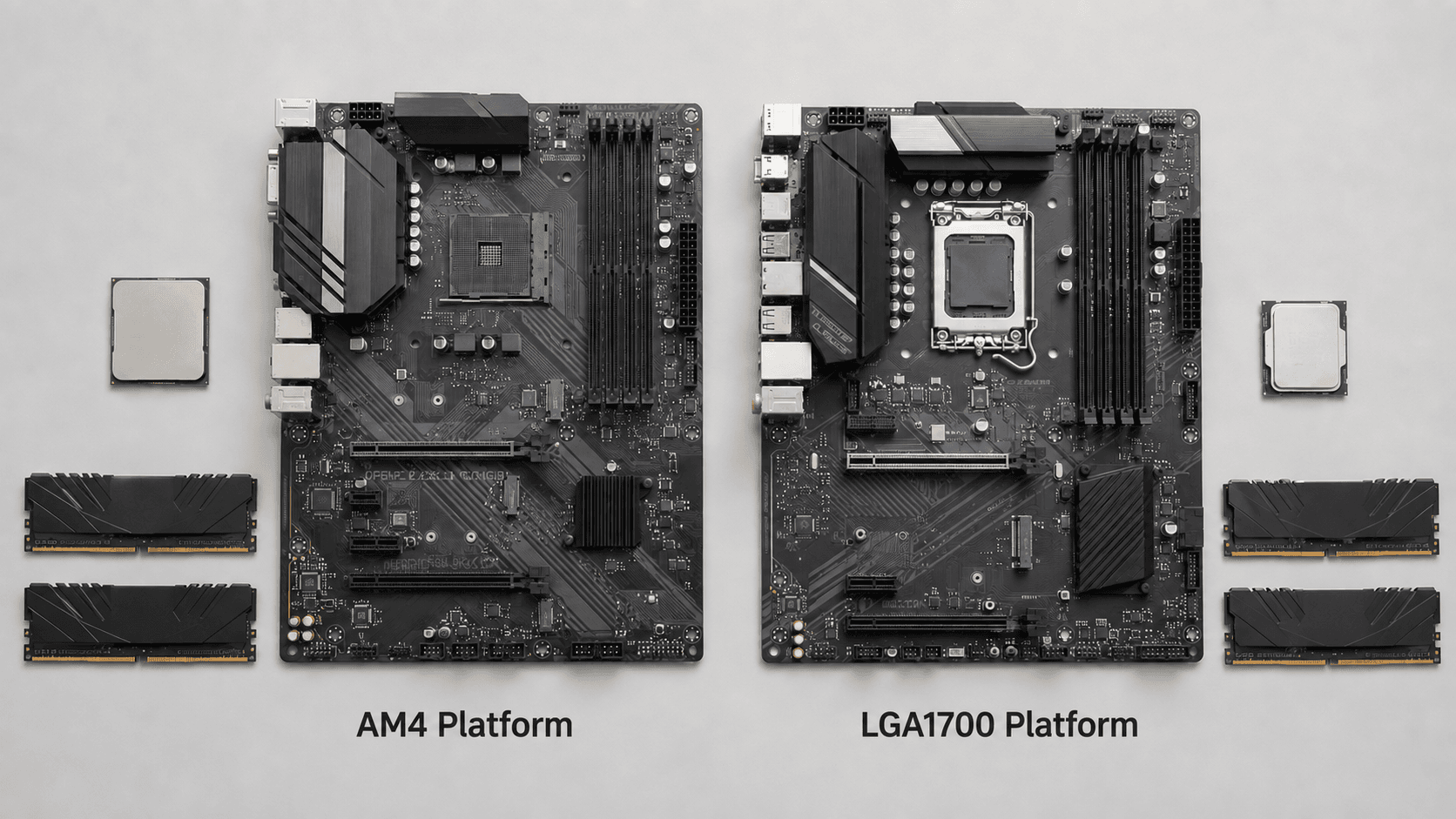
I've had readers ask me the same question three different ways this month: “I'm not touching DDR5 at these prices — but is my platform actually going anywhere?” That's really two separate questions wearing one costume, and conflating them is how people end up buying the wrong CPU. AM4 and LGA1700 both let you dodge the DDR5 tax right now. Only one of them is still getting new chips.
That distinction is the entire point of this article. Everyone's covered “DDR4 is cheaper than DDR5” already — that part isn't news. What nobody's laid out side by side is what happens a year from now, once you've already bought in. One of these platforms has a real, if unofficial, roadmap for 2027. The other one is being explicit that it doesn't. Below is exactly what each platform gets you today, what it locks you into, and which one to actually buy into depending on where you're starting from.
What This Guide Covers
1. Is This Platform Still Worth Upgrading In 2026?
Start with the number that's driving this whole decision: a 32GB DDR5-6000 kit runs roughly $375-450+ right now, up from $75-100 in late 2025. A comparable 32GB DDR4-3200 kit runs $187-227, according to Tom's Guide. That gap alone is why AM4 and LGA1700 both still make sense as active upgrade paths in 2026 instead of retirement-home platforms — DDR4 isn't a compromise right now, it's close to $200 cheaper for the same capacity.
What it isn't is a permanent safe harbor. Samsung, SK Hynix, and Micron have all shifted their DDR4 end-of-life timelines, and DDR4 kit prices have roughly doubled since late 2025 even while remaining far cheaper than DDR5, per Tom's Hardware's RAM price index. DDR4 is the better deal today. It will not always be the better deal, and manufacturers are actively winding down the supply that's keeping it that way.
So the question worth asking isn't “which platform is faster” — at matched price points, they're close enough that it barely matters, as I'll get into in Section 2. The real question is which platform still has a future once you've bought in. Here's the verdict up front: if you already own an AM4 board, buy the 5800X3D now — it's the best exit ramp AM4 will ever get, not a preview of more to come. If you're building fresh or want more runway before you're forced onto DDR5, LGA1700 is the safer long-term bet. Intel has now extended the platform twice, with a third round of new-in-box chips rumored for 2027, while AMD has given zero signal of anything coming after this. Same DDR4 economics today, very different outlook a year from now — and Section 3 is where that gap actually gets explained.
I'm deliberately separating those two questions because most coverage of this topic collapses them into one. A headline about “DDR4 vs DDR5 pricing” tells you nothing about whether the CPU you're buying today will be the last one your motherboard ever sees. Both platforms currently answer the pricing question the same way. Only one of them answers the roadmap question in a way that should change what you actually buy.
2. What CPUs Are Compatible (The Upgrade Ceiling)
AM4's ceiling is the Ryzen 7 5800X3D 10th Anniversary Edition, on sale since June 25, 2026 for $349, per Tom's Hardware. It's an 8-core, 16-thread Zen 3 chip with 96MB of L3 cache (100MB combined with the CPU's own cache), a 4.5GHz boost clock, and DDR4-only memory support. It drops into existing B450, X470, B550, or X570 boards. That's it — there is nothing above this chip on AM4, and nothing coming.
LGA1700's current ceiling is the Core i9-14900K (Raptor Lake Refresh), which runs on DDR4 or DDR5 depending on which motherboard you pair it with. The rumored “Raptor Lake Next” — expected to launch under Core 200 branding — is a different story, and a much lower one: reporting points to a Core 7-tier top end, 8P+12E cores (20 total), and a 65W power envelope. That is explicitly not a performance increase over the existing 14700K or 14900K, and there's no Core i9-class part planned at all.
Raptor Lake Next is a rumor, not a product
Every spec above traces back to leaker Jaykihn plus corroboration from VideoCardz and Tom's Hardware at Computex 2026 — Intel hasn't confirmed a launch, pricing, or final specs. Production is reportedly starting January 2027 with shelf availability in H1 2027. [VERIFY: exact clocks/cache for the rumored 10-core, 24MB L3 budget SKU — reported by VideoCardz, not finalized] [VERIFY: whether Raptor Lake Next requires a BIOS update on existing 600/700-series boards]
What matters more than the specs on paper is architecture: Raptor Lake Next reportedly reuses the same Raptor Cove/Gracemont hybrid design on the same Intel 7 process node as the existing 13th and 14th Gen chips — no new platform features. It would be fully backward compatible with existing 600/700-series LGA1700 boards, same as every Raptor Lake chip before it. In practice, that means it's the same chip family getting a third pass, not a new one.
At matched price points, the two platforms genuinely trade blows today. In live gaming tests around $300-310 — a Ryzen 7 5800XT on AM4 against an Intel Core i5-12600KF on LGA1700, both paired with the same DDR4-3200 CL16 kit at 1080p — neither side won cleanly, according to NoobFeed's head-to-head. But the framing matters more than the score: AM4 is already at its performance ceiling in that test — the 5800XT is close to the top of what the socket does. The LGA1700 side has headroom to move up to higher i7-class chips on the exact same board. AMD makes its own separate claim that the 5800X3D beats a Core i9-14900K by 10% on average at 1080p when the Intel chip runs DDR4-3600 — that's AMD's own number, not independently verified — and Tom's Hardware's own re-review backs up that the 5800X3D remains the fastest DDR4 gaming CPU available. Take both of those together and the picture is consistent: AM4 currently wins or ties on raw gaming performance, but it's doing that at its ceiling, while LGA1700 is doing it with room to grow on the same board.
3. What the Platform Locks You Into
This is the section that actually separates these two platforms, because on raw specs they're close enough to be a wash. AM4 is a confirmed dead end. Getting the 5800X3D relaunched required AMD to requalify its 3D V-Cache stacking process on newer TSMC manufacturing tech — confirmed by AMD's David McAfee and reported by Tom's Hardware. That's real, non-trivial engineering work — but it was a one-time effort to bring back exactly one chip, not the start of a continuing roadmap. AMD and every outlet covering it describe this as AM4's swan song.
LGA1700 is being extended for a second time. Intel already stretched the Raptor Lake silicon through a 13th Gen launch and a 14th Gen refresh, and Raptor Lake Next would be a third pass at that same underlying design. That means more new-in-box CPU options land through 2027 on LGA1700, even though — and this is the part worth being honest about — none of them raise the performance ceiling above what the 14900K already does.
Neither platform is getting faster. That's the flat truth underneath both roadmaps. What differs is which one is staying in production longer. AM4's answer is “this is it.” LGA1700's answer, if the rumors hold, is “one more round, then we'll see.” Both platforms currently let you buy a factory-new CPU and pair it with a reused or cheap DDR4 board, dodging the DDR5 tax entirely for now — the difference only shows up when you ask what happens after this chip.
4. The Best Upgrade for Each Platform's Owners Right Now
If you're already on AM4: buy the 5800X3D at $349 and stop waiting. It's the last legitimate upgrade the socket will ever get, and there is nothing on the horizon to hold out for. Tom's Hardware's own re-review calls it the fastest DDR4 gaming CPU available, though it falls well short of DDR4-era Intel competition in productivity and application workloads — so if your PC spends more time rendering than gaming, weigh that before buying.
If you're already on LGA1700: the Core i5-14600KF at $228 gets most of the way to current-gen performance without waiting on a rumored chip that isn't a real upgrade anyway, per Notebookcheck. If you need a board and RAM alongside it, there's an i5-14600K plus B760M-D4 motherboard plus 32GB DDR4-3600 bundle running $284 after promo on Slickdeals, which is a full CPU-plus-platform for barely more than the AM4 CPU alone costs.
Building fresh on a budget with no existing hardware to reuse: LGA1700 bundle deals currently undercut equivalent AM4 builds outright. Compare that $284 i5-14600K bundle against a reference AM4 build of a Ryzen 7 5800XT plus B550M motherboard at $309 combined, per NoobFeed — the Intel side already includes RAM in that number and still comes in cheaper. There isn't really an “it depends” here for a from-scratch build: Intel's bundle pricing wins on cost, and its platform roadmap wins on runway.
If your budget sits 20% below the $284-349 range covered above, the calculus doesn't change platforms so much as it changes which chip within each lineup you buy. On AM4, that means stepping down from the 5800X3D to whatever Ryzen 5000-series chip you can find cheapest rather than switching to LGA1700 for the sake of it — the platform-runway argument in Section 3 still applies at any price point within the same socket. On LGA1700, it means looking at a non-K i5 rather than the 14600KF, since the “-KF” suffix is paying for overclocking headroom most budget builders never use.
5. When It Makes More Sense to Switch Platforms
I don't want to oversell DDR4 loyalty here — it has real limits. If your workload leans productivity or rendering-heavy rather than gaming, DDR4-era chips on either platform fall behind current DDR5 platforms fast. Both the 5800X3D and the Raptor Lake lineup are gaming-strong, application-weak by comparison to their current-gen DDR5 successors, and no amount of platform loyalty changes that math for a video editor or 3D artist.
If what you actually need is a true upgrade ceiling — not just a sidegrade to a chip that's a re-release of existing silicon — AM5 or LGA1851 is the only way to get there. Both AM4 and LGA1700-with-Raptor-Lake-Next are, at best, extending the runway on a platform that has already stopped getting faster. That's a fine trade if your goal is dodging DDR5 pricing for another year or two. It's not a substitute for a platform that's still climbing in performance.
I've laid out the full same-socket-vs-platform-change cost framework, including exactly when that switch pays for itself, in When to Upgrade Your CPU. If you land on that page unsure whether you even need a new CPU yet, start there before you spend anything on either platform covered here.
6. Cost Breakdown: Upgrade vs. Platform Switch
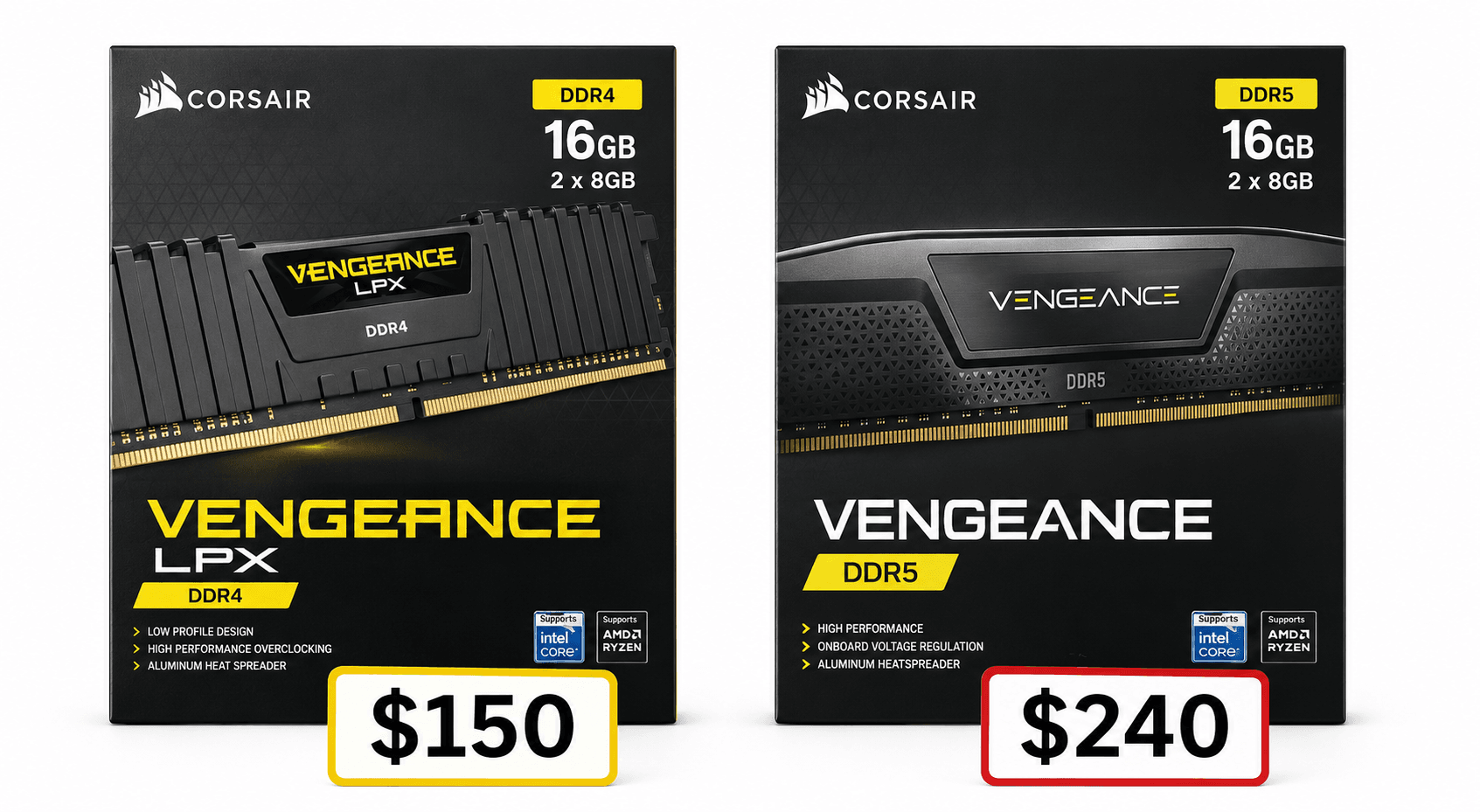
Here's the gap in dollars, staying on your existing DDR4 board and RAM versus jumping to a DDR5 platform. On AM4: a $349 5800X3D drop-in versus roughly $600+ to move to AM5 plus a DDR5 kit — that jump alone costs almost twice what the CPU itself does. On LGA1700: a $228-284 CPU (whether standalone or bundled with board and RAM) versus a similar $600+ jump cost to LGA1851 plus DDR5.
Put plainly: staying on either DDR4 platform costs a few hundred dollars for a CPU that drops straight into hardware you can already run. Switching platforms on either side costs roughly double to triple that, once you've added a new board and a 32GB DDR5-6000 kit at $375-450+. That gap is the entire reason this decision matters enough for its own article — the CPU price difference between AM4 and LGA1700 is almost a rounding error next to what a full platform switch costs on either side.
Break it into line items and it holds up the same way on both sides. AM4, staying put: $349 for the CPU, $0 for a board and RAM you already own. AM4, switching to AM5: $329-plus for the 7700X3D-class chip, roughly $150-200 for a budget B650 board, and $375-450+ for the DDR5 kit — that's the $600+ figure above, and almost three-quarters of it is the RAM line alone. LGA1700, staying put: $228-284 depending on whether you need a board and RAM alongside the CPU. LGA1700, switching to LGA1851: a comparable CPU cost plus a new board plus that same $375-450+ DDR5 kit, landing in the same $600+ neighborhood. The RAM line is what moves the needle on both platforms — the CPU and board costs are close enough between generations that they barely factor in.
The number that should actually drive your decision isn't the CPU price — it's whether that few hundred dollars buys you one more upgrade or the last one your platform will ever offer. Section 3 already answered which is which.
7. Common Mistakes Owners Make
The mistake I keep seeing in AM4 threads: assuming the socket will get more chips after the 5800X3D. It won't. AMD's own framing of this relaunch — a one-time requalification of an old manufacturing process to bring back exactly one chip — is the opposite of a roadmap. Treat the 5800X3D as the final AM4 purchase you'll ever make, because that's exactly what AMD is telling you it is.
Don't assume Raptor Lake Next is a faster chip
The Core 200 series rumors point to a re-release of existing Raptor Cove/Gracemont silicon on the same Intel 7 node — not a performance jump. No Core i9-class part is planned, and reported specs sit below the existing 14900K. It exists to extend platform availability, not to raise your ceiling above what you can already buy today.
The third mistake is panic-buying DDR5 right now out of fear that DDR4 is about to disappear entirely. It isn't — not on a timeline that should change a purchase you're making this year. DDR4 prices have roughly doubled since late 2025 as Samsung, SK Hynix, and Micron shift production, but it's still $150-280 cheaper than DDR5 at the 32GB tier. If your platform still supports it and you're building or upgrading now, riding out DDR4 a while longer is the better call than jumping to DDR5 out of fear of a shortage that hasn't actually hit DDR4 supply yet.
The fourth mistake is treating the two platforms as identical just because they trade blows in benchmarks today. The matched-price gaming test in Section 2 shows near-parity right now, but it also shows AM4 already sitting at its ceiling while LGA1700 has room to move up to higher i7-class chips on the same board. A benchmark snapshot from July 2026 tells you nothing about which platform still has a chip to sell you in July 2027 — that's a roadmap question, not a performance one, and it's the one this whole article is built around.
Frequently Asked Questions
Is Intel's new DDR4 CPU (Raptor Lake Next) actually confirmed?
No. Everything about it — codename, Core 200 branding, specs — comes from leaker Jaykihn and reporting from VideoCardz and Tom's Hardware at Computex 2026. Intel hasn't confirmed a launch, pricing, or exact specs. Treat it as a strong rumor with a realistic H1 2027 timeline, not a done deal.
Will Raptor Lake Next be faster than my current 13th or 14th Gen CPU?
Almost certainly not. It's expected to use the same Raptor Cove/Gracemont silicon on the same Intel 7 process, and rumors point to a lower ceiling than the existing i9-14900K, with no Core i9-class part planned. It exists to extend platform availability, not to raise performance.
Is AM4 really finished, or will AMD release more chips?
All signs point to finished. The 5800X3D 10th Anniversary Edition required AMD to requalify an older 3D V-Cache manufacturing process specifically to bring this one chip back, and both AMD's own framing and outlet coverage describe it as a last exit ramp rather than the start of a new lineup.
Should I buy DDR4 or DDR5 right now if I'm building new?
If your CPU choice doesn't require DDR5, DDR4 is the better value today — a 32GB DDR4 kit runs $187-227 versus $375+ for equivalent DDR5. Just don't treat DDR4 as a permanent safe harbor; prices have already roughly doubled since late 2025 as manufacturers shift production.
Which platform has better long-term upgrade prospects, AM4 or LGA1700?
LGA1700, if Raptor Lake Next materializes as rumored. Intel has now extended the platform twice and appears set to do it a third time into 2027. AM4 has no equivalent roadmap — the 5800X3D re-release is explicitly a farewell, not a first step.
What to Read Next
- Is Building an AM4 PC Worth It in 2026? → The full AM4-specific deep dive on whether the platform is worth building on in 2026, including the real from-scratch cost math against AM5.
- When to Upgrade Your CPU → For readers unsure whether a CPU upgrade is the right move at all, plus the general same-socket-vs-platform-change cost framework.
- How Much RAM Do You Need in 2026? → For readers who landed here from a RAM-crisis search but actually need a capacity-sizing answer, not a CPU one.