Does FSR 4.1 Make Your RX 7000 GPU Faster?AMD's July 2026 driver update finally brought FSR 4.1 to RDNA 3 — here's the performance trade-off most coverage left out.
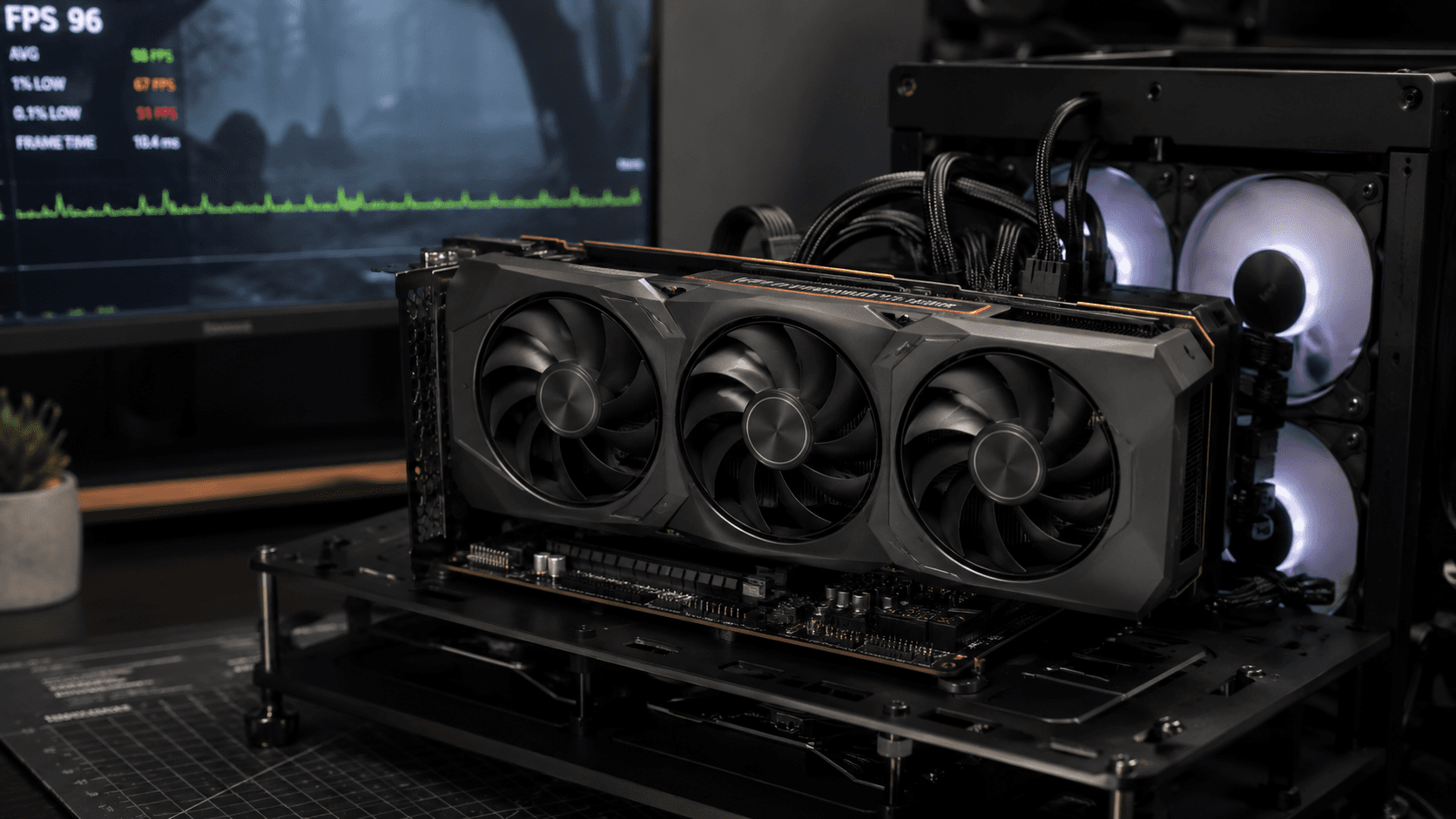
I updated my RX 7800 XT test rig the day AMD's driver landed, expecting free frames. I got the opposite. Cyberpunk 2077 ran slower on FSR 4.1 than it had on FSR 3.1 the night before — noticeably slower, not a rounding error — and the only thing I got in return was cleaner foliage and less shimmering on distant detail. That's the trade nobody's headline mentioned when this update shipped.
AMD pushed FSR 4.1 support for the entire RX 7000 lineup through the Adrenalin 26.6.2 driver on June 22, 2026 — eight days ahead of its own schedule — with day-one support across 300+ games. That's a genuinely fast rollout. It's also, based on the benchmark data that's come in since, a straight trade of frames for pixels, not an upgrade in the way most people assumed a new upscaler version would be.
What This Guide Covers
1. The Direct Answer
FSR 4.1 on RX 7000 is 7 to 14% slower than FSR 3.1 at the same preset — not faster. It does deliver meaningfully better image quality: sharper detail, less shimmering on foliage and fine geometry, and cleaner motion overall. What AMD shipped is an image-quality upgrade wearing performance-upgrade marketing, and the two things are not the same purchase decision.
On the RX 7800 XT — the most common card in this lineup — Quality mode drops 7% and Performance mode drops 9% when you switch from FSR 3.1 to FSR 4.1, according to ComputerBase's conclusion page from its 9-game 1440p test suite. On the flagship RX 7900 XTX at 4K, Guru3D's coverage of the same testing shows Quality mode down 11% and Performance mode down 14.5%. This isn't a one-game anomaly or a driver bug that gets patched out — it's consistent across the entire RDNA 3 lineup, from the flagship down to entry-level cards.
2. The Data: What Benchmarks Actually Show
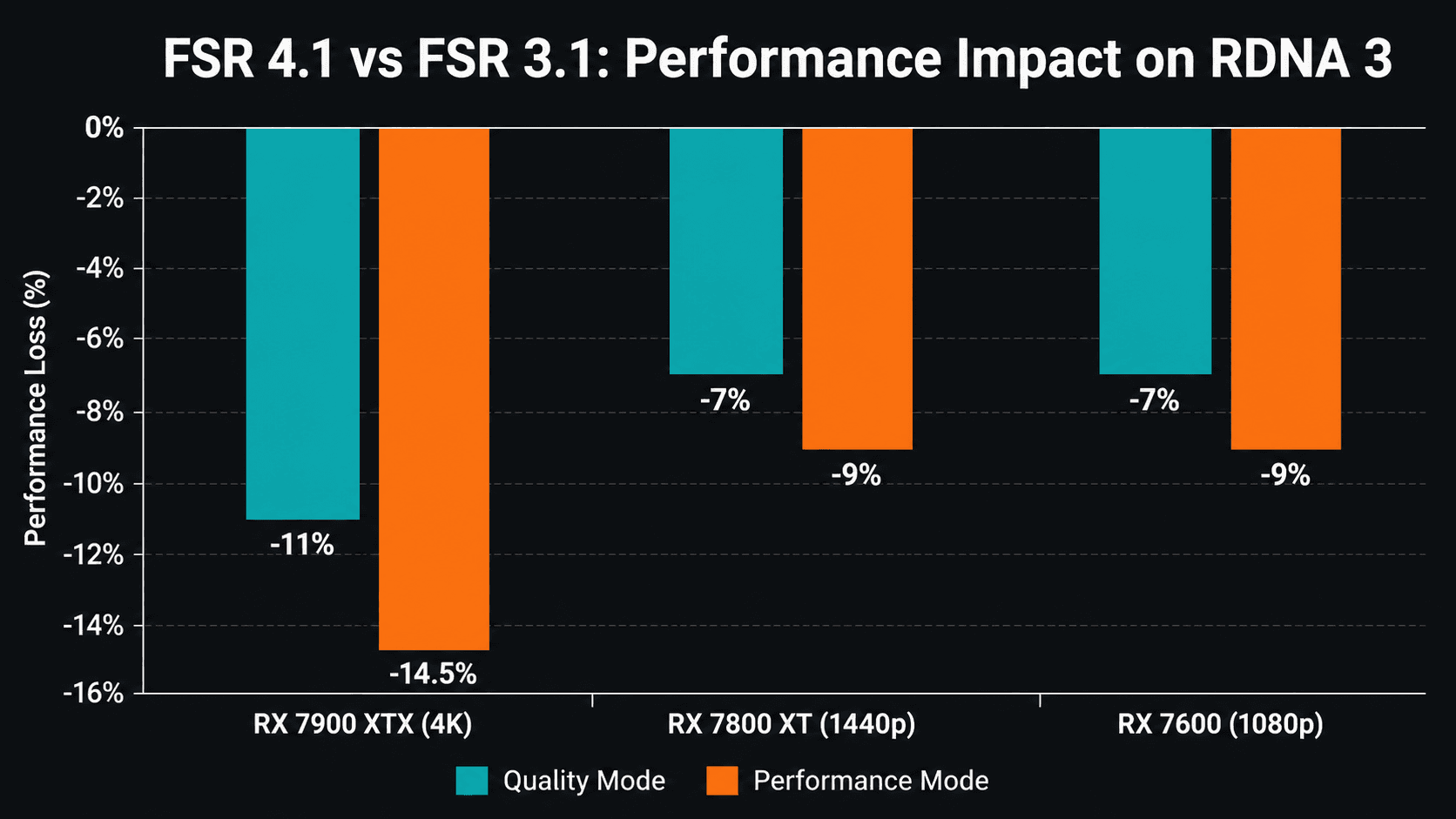
The clearest way to see the pattern is card by card, on the final shipped Adrenalin 26.6.2 driver, tested by ComputerBase and cross-referenced by Guru3D on a 9-game average:
| Card | Test Conditions | Quality Mode | Performance Mode |
|---|---|---|---|
| RX 7900 XTX | 4K, 9-game average | 11% slower | 14.5% slower |
| RX 7800 XT | 1440p, 9-game average | 7% slower | 9% slower |
| RX 7600 | 1080p, 9-game average | 7% slower | 9% slower |
All figures are FSR 4.1 versus FSR 3.1 at the same preset on the same card — not a cross-generation comparison. The RX 7800 XT and RX 7600 land on identical percentages despite sitting at different price points and resolutions, which tells you this isn't about a specific game engine or a specific tier of card. It's the same regression, scaled down.
The reason comes down to hardware, not software polish. RDNA 4 cards like the RX 9070 XT ship with native FP8 AI accelerators built specifically for this kind of upscaling model. RDNA 3 — every RX 7000 card — has no FP8 hardware at all. To get FSR 4.1's machine-learning model running on RX 7000, AMD adapted it to run on INT8 instead, which is the closest thing RDNA 3's compute units support. INT8 execution loads those existing compute units more heavily than the lighter FSR 3.1 algorithm did, and that extra load is exactly what shows up as the FPS drop. It's an architecture ceiling, not a bug — which is why Guru3D's reporting was blunt about calling it a performance regression rather than a rough launch.
3. How Much It Matters in Practice
Percentages are easy to wave off until you see them as actual frame counts. In one title benchmarked by TechSpot and cited in Igor'sLab's coverage, FSR 4.1 Performance mode landed at 66 FPS against 61 FPS on FSR 3.1 Quality mode — meaning even the "faster" preset on the new upscaler still traded away enough performance that the comparison isn't clean-cut in FSR 4.1's favor once you're picking equivalent visual settings.
My rule of thumb: a 7-9% loss is close to invisible once you're already sitting above your monitor's refresh rate. If your 1440p panel caps out at 100Hz and FSR 3.1 was giving you 140 FPS, dropping to 128 FPS on FSR 4.1 changes nothing you'll feel — you were already capped. Where it does matter is competitive and high-refresh play, where every frame above your current ceiling is the actual point of the setting. A 165Hz or 240Hz player running FSR 3.1 at 180 FPS and dropping to 164 FPS on FSR 4.1 has given up real, usable headroom for an image-quality gain they likely won't register mid-match.
4. When the Answer Changes
Stick with FSR 3.1 if you play competitive titles or you're running a high-refresh monitor where every frame above your current ceiling is the reason you bought that panel. The 7-14% you'd give up is real headroom in exactly the scenario where headroom is the point.
Switch to FSR 4.1 if you weren't frame-limited to begin with and shimmering, ghosting, or unstable fine detail were the things actually bothering you. That's the honest use case AMD built this for, and on RX 7000 it delivers on the image-quality half of the promise even though it can't deliver the performance half.
One thing this driver update does not change regardless of which preset you land on: Frame Generation stays RDNA 4-exclusive. AMD only ported the upscaling model to RX 7000 — the frame-generation half of FSR remains locked to RX 9000-series hardware, per TweakTown's reporting. If part of what you were hoping for was AMD-side frame generation on your existing card, this update doesn't bring it — no matter which FSR version you settle on.
5. What to Do If You're Actually Bottlenecked
None of this changes the math if your real problem is raw horsepower rather than image quality. FSR 4.1 adjusts what your RX 7000 card looks like at its current performance ceiling — it doesn't raise that ceiling. If you're genuinely bottlenecked, that's a separate, bigger question, and this driver update didn't touch it either way.
The RX 7800 XT's native raster performance still trails the RX 9070 XT by roughly 16% at 1440p in mixed workloads, and by up to 25-35% in newer AAA titles, according to DropReference's comparison data. That gap exists with zero RDNA 3 upscaler penalty involved — it's purely the RDNA 4 architecture and its native FP8 accelerators doing more with the same frame. The RX 9070 XT is currently running $650-720 street on Newegg and Amazon as of July 2026, with occasional doorbuster drops to $504-530 worth watching for if you're patient. The RX 7800 XT, for reference, has stayed flat at $500-600 street since its 2023 launch.
My honest take: don't spend money fixing a problem that a free driver update already fixed. If shimmering and image stability were your actual complaint, FSR 4.1 solved that for nothing. If low FPS was your complaint, this update never touched it, and the real fix is still a GPU upgrade — not a settings change. Run through the GPU upgrade checklist before you buy anything, so you confirm the bottleneck and the compatibility math before spending on a new card.
Frequently Asked Questions
Does FSR 4.1 make my RX 7000 GPU faster than FSR 3.1?
No. Across every RDNA 3 card AMD tested — RX 7900 XTX, RX 7800 XT, and RX 7600 — FSR 4.1 runs 7 to 14.5% slower than FSR 3.1 at the same preset. The image quality is noticeably better, but it's a real frame-rate cost, not a bonus.
Why is FSR 4.1 slower on RX 7000 than on RX 9000?
RDNA 4 has dedicated FP8 AI accelerators built for this workload. RDNA 3 has no FP8 hardware, so AMD adapted the model to run on INT8 instead, which loads the card's existing compute units more heavily. It's an architecture limitation, not something a future driver fixes.
Should I switch to FSR 4.1 or stay on FSR 3.1?
If you're chasing max FPS on a high-refresh monitor or playing competitive titles, stay on FSR 3.1. If you weren't frame-limited and shimmering or ghosting bothered you, FSR 4.1's cleaner image is worth the trade. It depends on which one you were actually short on.
Does this update mean I don't need to upgrade my RX 7000 GPU?
Not necessarily. FSR 4.1 changes image quality at your current performance level — it doesn't add horsepower. If you're genuinely bottlenecked, a RX 7800 XT still trails a RX 9070 XT by roughly 16 to 35% in native rendering, and that gap is what a real upgrade closes.
When is FSR 4.1 coming to RX 6000 series cards?
AMD has said early 2027 without an exact date, per PC Gamer's reporting. RX 6000 has no dedicated AI accelerators at all, which AMD has flagged as a harder problem than the RX 7000 port — expect the performance trade-off to be at least as large. [VERIFY: RX 6000/RDNA 2 numbers don't exist yet — keep any RDNA 2 mention clearly forward-looking]
What to Read Next
- Should I Upgrade My GPU? → Before you buy — see whether AMD's free driver update already solved your problem without new hardware.
- How to Fix Low FPS in Games → For readers who haven't ruled out software or driver causes before assuming it's a hardware problem.
- Best GPU for 1440p Gaming in 2026 → Still on RX 7000? Check whether AMD's free driver update already covers what you're looking for before buying a new card.