Should You Buy an SSD Now, or Wait Out the NAND Shortage?Storage already doubled or tripled in price. Here's whether the worst has passed — and what to actually do about it.
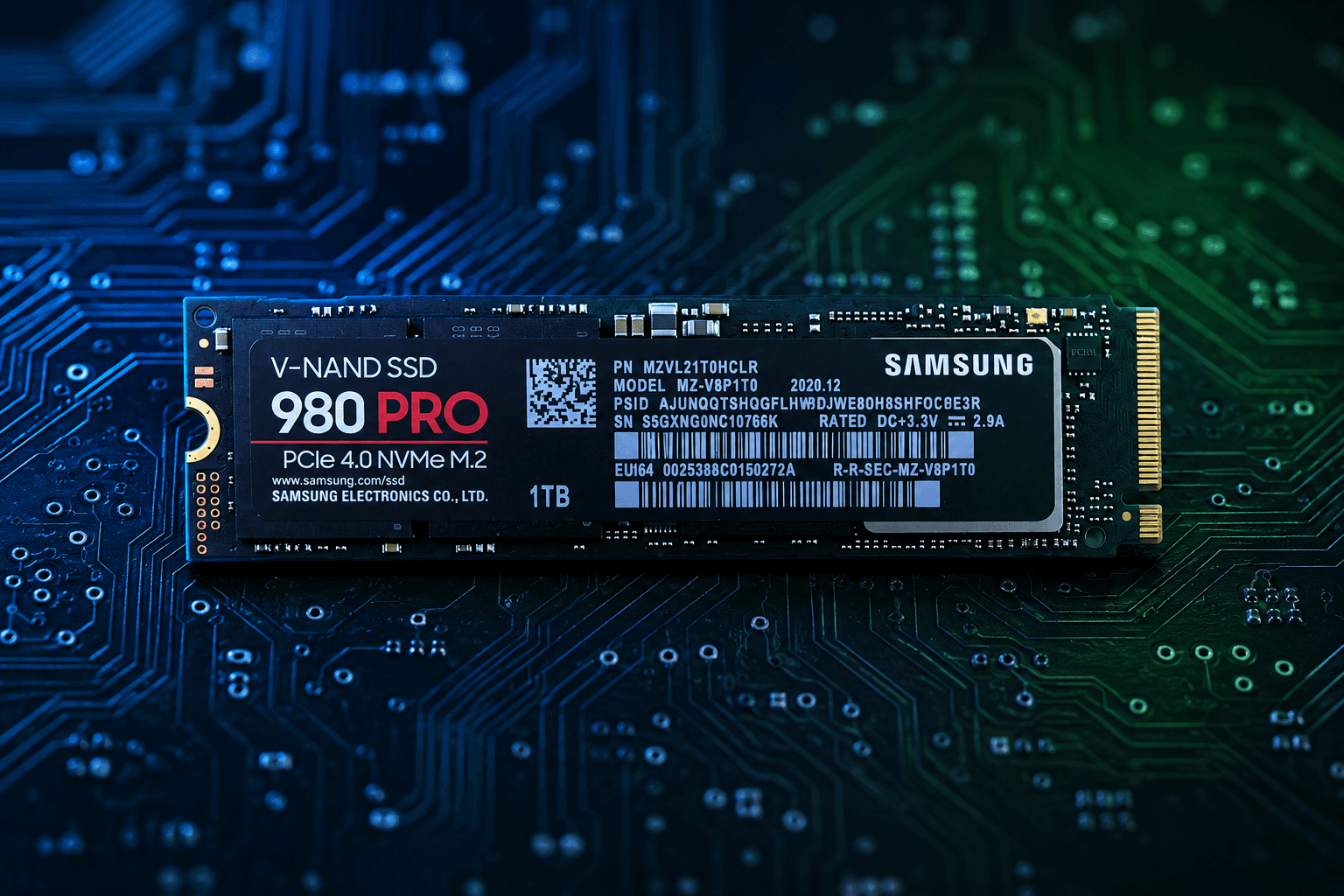
In March I told a client to hold off on his 2TB drive until prices settled down. Two months later he paid $80 more for the exact same model I'd talked him out of buying at the lower price. That's the mistake this article exists to stop you from making — not because SSD prices are about to spike the way RAM did, but because they already have, and now that the pace is finally slowing down, it's tempting to read that as “the worst is over” when it just means the bleeding slowed from severe to steady.
This isn't the “storage is about to get hit” story I wrote about RAM back in the spring. That drama already happened to SSDs — Samsung, Crucial, Lexar, and Kingston have all roughly doubled or tripled their consumer 1TB pricing since October 2025. The useful question now isn't whether to brace for a shortage. It's whether the deceleration in the quarterly data means relief is coming, or just means the same climb at a gentler grade. Below is the actual NAND contract price trajectory quarter by quarter, why it's slowing without reversing, and what that means depending on whether you're building new or upgrading what you have.
What This Guide Covers
1. The Direct Answer
If you need storage for a build or upgrade that's actually happening, buy now. Kioxia — the third-largest NAND maker, with 14%+ market share — told Tom's Hardware in January that “this year's production is already ‘sold-out,’” a status the company expects to continue through at least 2027 — the same executive put it more bluntly: “The window for affordable SSDs closed a couple of months ago.” Western Digital's CEO Irving Tan told investors in February that the company is “pretty much sold out for calendar 2026,” with firm purchase orders locked in with its top seven customers stretching into 2027 and 2028. Two of the largest storage manufacturers in the world are independently telling investors, not marketing copy, that there isn't spare capacity sitting around waiting for retail demand.
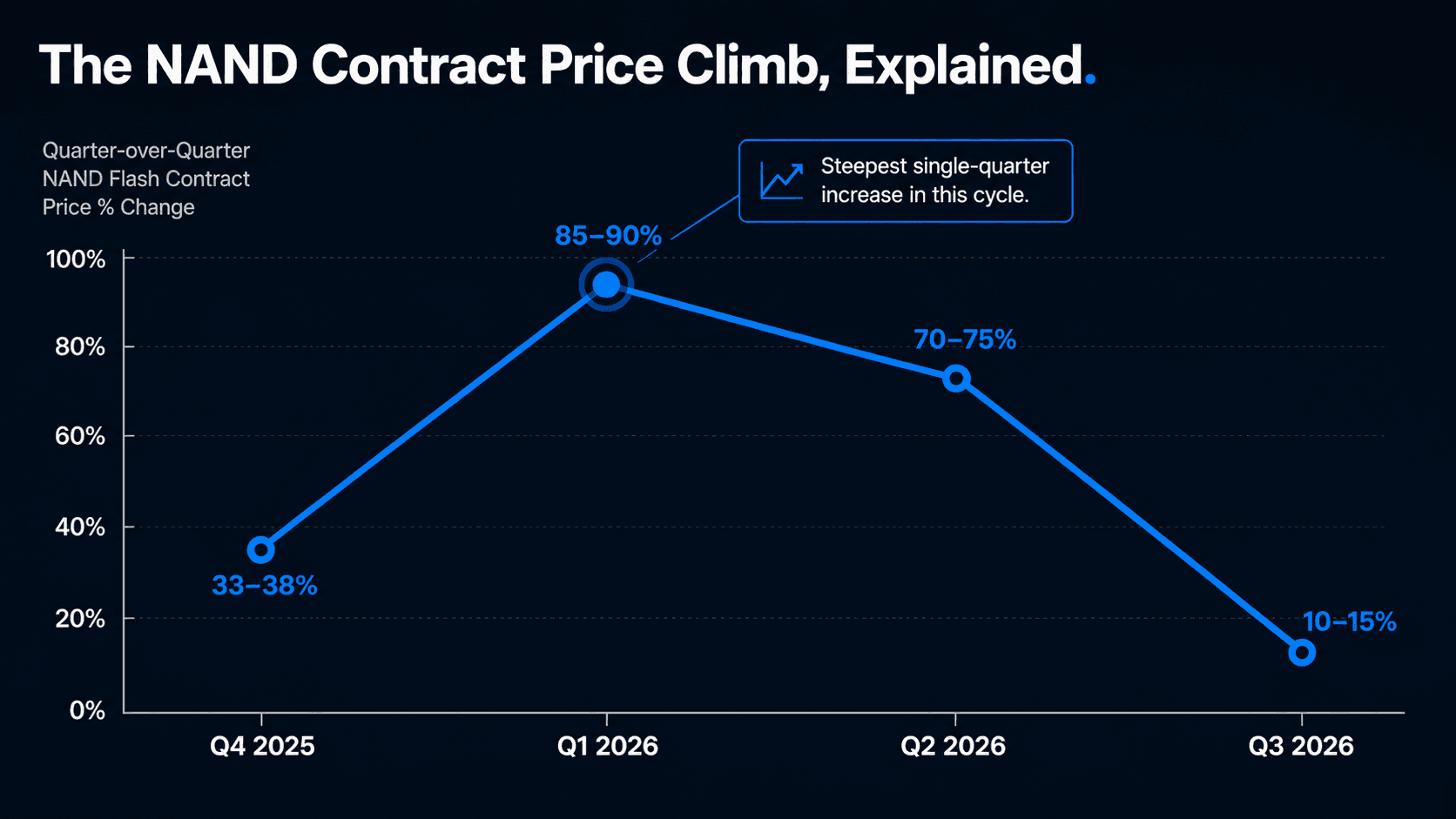
But don't panic-buy capacity you don't need. The rate of increase in NAND contract prices just dropped from 70-75% quarter-over-quarter in Q2 2026 to 10-15% in Q3 2026, per TrendForce's July 3 press release — the slowest pace of the entire cycle. That deceleration means the free-fall phase is over. It does not mean prices are coming down. A 10-15% quarterly increase stacked on a base that's already roughly doubled to tripled since late 2025 is still a real, ongoing cost increase — just a steadier one than the 85-90% jump the market absorbed in Q1.
This isn't the RAM story again, at least not in the sense of watching a spike happen in real time. The SSD spike already happened. What's left is the more useful, more concrete question the rest of this article answers: does “slower” mean “almost done,” or does it mean something else entirely.
2. Why NAND Prices Exploded
The same factories that produce the NAND flash in a $70 consumer SSD also produce the flash going into enterprise and AI-server SSDs. When an enterprise customer will pay several times more per gigabyte than a retail buyer, and that enterprise customer is buying in volumes measured in exabytes for AI training clusters, the factory allocates wafer capacity to the higher-margin buyer first. Consumer SSDs get whatever's left.
Phison's CEO put a number on how fast this shift moved: NAND flash prices doubled in six months, according to TechPowerUp's coverage of his comments. Phison traces the pivot back to around 2023, when capital that would have gone toward new NAND capacity started flowing toward high-bandwidth memory (HBM) for AI training instead — and new NAND fab capacity isn't expected to come online until 2027. Phison's own financials show exactly where that capital went: Q3 2025 revenue up 30% year-over-year, October 2025 up 90% year-over-year, driven by a 280% surge in SSD controller sales, with the company deliberately shifting toward higher-margin enterprise and industrial customers and cutting retail shipments. Phison expects enterprise SSDs to make up 20-30% of its revenue by 2026.
This wasn't just passive scarcity, either. Samsung, SK hynix, Kioxia, and Micron reportedly coordinated output cuts in the second half of 2025 specifically to push NAND prices higher after they'd been hovering near cost, according to TrendForce News, citing Chosun Biz. Samsung lowered its NAND wafer output from 4.9 million to 4.68 million units year-over-year; SK hynix followed a similar path, from 1.9 million to 1.7 million, per GamersNexus's reporting on the same ChosunBiz/Omdia data. Suppliers didn't just fail to expand capacity — they actively constrained it.
The part of this that worries me most for the budget end of the market: the mature-node manufacturing lines that produce cost-effective 512GB-class TLC chips are being retired entirely, not just deprioritized, according to elinfor.com. When those fabs close, that specific slice of cheap supply doesn't shrink temporarily — it disappears. There's no reopening a decommissioned fab line once the industry has moved on to newer, larger-capacity nodes built for enterprise customers.
3. The Data: How Bad It's Actually Gotten
Walk through the actual drives. A Samsung 990 Pro 1TB ran about $90 in October 2025; by March 2026 it was listed at roughly $200, per style-review.com's best-NVMe-SSD roundup. A Crucial P310 1TB went from $69 to $107-$138 in early 2026, and is currently sitting at $174.99 on Amazon as of this writing, according to GamesRadar's weekly SSD deals tracker. A Lexar NM790 1TB moved from $66 to $118, also per style-review.com. Across 1TB consumer SSDs generally, the move has been from around $45 to around $90 since late 2025, according to nand-research.com's Memory & Flash Crisis update from March 2026. Even budget-tier drives aren't exempt — the Kingston NV3 1TB went from 80€ to 160€, per dropreference.com.
Higher-capacity drives show the same pattern at a bigger dollar scale. A WD Black SN850X 2TB ran about $130 at the end of 2024 and is currently listed at $297 as of July 2026, per GamesRadar and Tom's Hardware's price tracker. And the enterprise side shows the ceiling case for how extreme this gets: a 30TB TLC enterprise SSD went from $3,062 in Q2 2025 to $17,500 in Q1 2026 — a 472% increase — according to dropreference.com, citing TrendForce. That number matters even if you'll never buy an enterprise drive, because it shows this isn't just retail markup opportunism. It's the same underlying wafer shortage, just visible at a scale where the math can't hide.
Retail prices are actually a lagging reflection of a much sharper move upstream. The 512Gb TLC wafer spot price jumped 25% in a single month — February 2026 — the steepest monthly gain reported that cycle, according to Tom's Hardware. Zooming out further, 1Tb QLC/TLC flash wafer prices have roughly tripled since October 2025, and 512Gb TLC wafer prices are up nearly fivefold over the same period, per DigiTimes/ChinaFlashMarket data cited by Tom's Hardware. Retail SSD prices doubling or tripling sounds dramatic until you see that the raw wafer cost behind them moved even faster.
[VERIFY: Ali, if you want a Pakistan-specific price point for the hook or a callout box, check a local retailer — I only have verified US/EU prices above.]
4. Is the Worst Actually Over?
Here's the quarter-by-quarter NAND contract price trajectory, and it's the core argument of this whole article. Q4 2025: +33-38% quarter-over-quarter, per TrendForce's January 5, 2026 press release. Q1 2026: revised up to +85-90% quarter-over-quarter — worse than the original 55-60% forecast — according to dropreference.com, citing TrendForce, and corroborated by Kingston's Cameron Crandall reporting a 246% cumulative NAND wafer price rise versus Q1 2025. Q2 2026: +70-75% quarter-over-quarter, per Ampheo's memory market forecast, also citing TrendForce. Q3 2026 — the current quarter, reported July 3, 2026: +10-15% quarter-over-quarter, the slowest pace of the entire cycle, according to TrendForce's press release on AI server demand continuing to support memory prices into Q3.
Why is it decelerating? TrendForce attributes it to consumer price tolerance hitting its ceiling and a higher year-over-year comparison base — not to suppliers loosening up. In plain terms: buyers are pulling back at these prices, which caps how fast sellers can keep raising them, and the percentage increase looks smaller partly because it's being measured against an already-inflated prior quarter. Neither of those reasons is a supply-side signal. Nothing in the Q3 data says Samsung, SK hynix, Kioxia, or Micron have added capacity back.
This is exactly where I want to stop the instinct to relax. A 10-15% increase is still a price increase, sitting on top of a base that's already roughly doubled to tripled since late 2025 — and suppliers are still sold out. Kioxia and Western Digital didn't say prices were leveling off; they said their 2026 capacity is already gone. Reading “the increase slowed down” as “the shortage is ending” is the single most common mistake I'd expect readers to make with this data, and it's wrong.
Real relief isn't expected before 2027-2028 — and even then, not to old prices
Analysts don't expect meaningful relief until new NAND fab capacity comes online in 2027-2028 at the earliest — the same 2027 timeline Phison's CEO cited for new capacity, and the same window Kioxia says its own production stays sold out through. Even once that capacity arrives, prices aren't expected to return to 2023-2025 levels, because the demand pulling NAND toward AI infrastructure is structural, not a temporary spike that unwinds on its own.
5. If You're Building a New PC Right Now
Buy the storage now if the build is actually happening. Every quarter of waiting has meant a higher price for the same drive since October 2025 — the Samsung 990 Pro, Crucial P310, and Lexar NM790 numbers above all move in one direction — and nothing in the Q3 2026 data suggests that reverses. Waiting for the “slower” quarter to become an actual price drop is waiting for something the data doesn't support.
Buy exactly the capacity you need, not more. Stretching to a bigger drive “just in case” prices climb further is speculating with your build budget, the same mistake I'd warn against with RAM. If your build genuinely needs 1TB, buy the 1TB drive — don't talk yourself into 2TB because the price gap might widen later. That's a bet, not a purchase decision grounded in what you actually need.
If you're shopping around, check bundle deals — an SSD paired with a motherboard or a prebuilt system — the same way I'd recommend checking RAM bundles during the DDR5 crunch. I want to be honest that this is a tactic worth trying, not a guaranteed source of savings — I didn't find a verified current SSD bundle example in the research for this piece the way I did for RAM. Still, if you're assembling a full parts list anyway, it costs you nothing to check whether a bundle beats the standalone drive price before you buy it separately.
6. If You're Upgrading Existing Storage
If you're still on an HDD, the case for switching to an SSD hasn't gone away — the mechanical bottleneck an SSD fixes is the same one it's always fixed, and I cover that performance case in full in Should I Upgrade to an SSD?. What's changed is the price: expect to pay roughly double to triple what this upgrade would have cost in 2025, based on the 1TB consumer SSD data above. The upgrade is still worth making if you need it — it just costs more than it used to, and that's worth budgeting for honestly instead of being surprised at checkout.
If you already have an SSD and are just considering more capacity, apply the same gut check I'd recommend before any upgrade during a price spike: check whether you're actually running low on space before buying more at inflated prices. If you're sitting comfortably above 15-20% free space and haven't been hitting “low disk space” warnings, more storage right now isn't solving a problem you have — it's just spending money because the option is there.
And “just get a cheap hard drive instead” isn't the escape hatch it used to be. This same sold-out dynamic is playing out in HDDs, not just SSDs and NAND — Western Digital and Seagate have both confirmed their 2026 hard drive capacity is sold out to hyperscalers, according to heise online, which is pushing some of that displaced demand onto SSDs and compounding the SSD price pressure further. There's no cheaper storage tier quietly sitting this shortage out.
7. What NOT to Do
Don't wait for a “sale” assuming it reflects a real trend reversal. As with RAM, some apparent discounts are a retailer clearing existing inventory ahead of another reprice, not genuine relief — a drive that's $10 cheaper this week doesn't mean next month's stock will be priced the same way. Don't overbuy capacity “just in case” either — the same principle from the RAM shortage applies here: buying more than your workload needs to hedge against a future price move is speculation, not a purchase decision.
[VERIFY: Ali — no counterfeit-SSD warning source found in this research pass the way the RAM article had for DDR5. If you want that angle for SSDs too, flag it and I'll do a follow-up search; otherwise I haven't invented one here.]
And don't assume HDDs are the cheap fallback anymore. Western Digital and Seagate have both confirmed their 2026 hard drive production is already sold out — the same dynamic hitting SSDs is hitting spinning disks too, just less severely. Circling back to where this started: if the build or upgrade is actually happening, buy the storage now — the sold-out data and the wafer price trajectory both point the same direction. If it isn't happening yet, don't let the shortage talk you into buying capacity ahead of when you'll actually use it.
Frequently Asked Questions
Will SSD prices in 2026 ever go back to normal?
Not this year, and probably not in 2027 either. Kioxia's own management says its capacity is sold out through at least 2027, and analysts don't expect meaningful relief until new NAND fab capacity comes online in 2027-2028. Even then, prices likely won't return to pre-2025 levels, since the underlying driver — AI data centers absorbing NAND capacity — is structural, not a temporary blip.
SSD price increases have slowed down — does that mean the shortage is ending?
No. NAND contract prices are still rising, just at 10-15% quarter-over-quarter instead of 70-90%. That slower pace mostly reflects consumers hitting their affordability limit and a higher year-over-year comparison base, not suppliers loosening up. Kioxia and Western Digital have both confirmed their 2026 production is already sold out.
Are SSD prices rising as much as RAM prices?
Not quite as much in percentage terms — RAM (specifically DDR5) has seen steeper single-quarter jumps. But SSD prices have still roughly doubled to tripled for many popular models since late 2025, and the two shortages are driven by the same underlying cause: NAND and DRAM factories both reallocating capacity toward AI infrastructure.
Should I just buy a hard drive instead of an SSD to avoid the price hike?
That escape hatch is mostly closed. Western Digital and Seagate have both confirmed their 2026 hard drive production capacity is already sold out to AI data center customers, so HDD prices have risen too, though the SSD/NAND squeeze is generally sharper.
How much storage should I buy right now?
Buy what your actual workload needs, not more. Stretching to a bigger drive “just in case” prices climb further is speculating with your upgrade budget rather than solving a problem you actually have — the same mistake this shortage tempts people into with RAM.
What to Read Next
- RAM Shortage 2026: Upgrade Now or Wait? → The sibling piece: same AI-driven memory crisis, same buy-now-or-wait framework, applied to RAM instead of storage.
- Should I Upgrade to an SSD? → For readers who haven't yet decided whether an SSD upgrade makes sense at all, before factoring in current pricing.
- Should You Upgrade RAM or SSD First? → For readers trying to prioritize between the two given both are affected by the same shortage.