RX 9070 vs RTX 5070: Which Mid-Tier GPU Is Actually the Better 1440p Upgrade?The performance gap has grown since launch, and this month, so did the price gap.
If you're choosing between the RX 9070 and RTX 5070 for a 1440p upgrade this month, buy the RX 9070. It's now running about 13% faster in rasterized games than when it launched, thanks to driver updates that widened AMD's lead instead of shrinking it, and as of August 2026, it costs $150 to $250 less than the RTX 5070 at street price. That's not a close call anymore.
Both cards launched at the same $549 MSRP in early 2025. Neither sells anywhere close to that now, and the gap between them has been moving in one direction: wider. This article walks through why, using current street prices, benchmark data from Hardware Unboxed and GamersNexus, and a verdict that doesn't hedge on who each card is actually for.
What This Guide Covers
1. The 30-Second Verdict
Here's the shape of it. Across a 23-game suite at native 1440p, the RX 9070 averages 13% faster than the RTX 5070 in rasterized games, up from a 4% gap at launch. On Amazon right now, the RX 9070 runs $619.99 against $799.99 for the RTX 5070, and that gap widened further this month as RTX 5070 pricing jumped 36% between July and August 2026. Put those two numbers together and the RX 9070 is both the faster card and the cheaper one for most 1440p buyers.
The one caveat worth stating up front: if you play ray-traced or path-traced titles regularly, the RTX 5070 has a real, consistent advantage there, and that's the one scenario where paying more for it still makes sense. Everything else in this article is about quantifying exactly how much more you'd be paying, and for what.
2. Price Reality Check (August 2026)
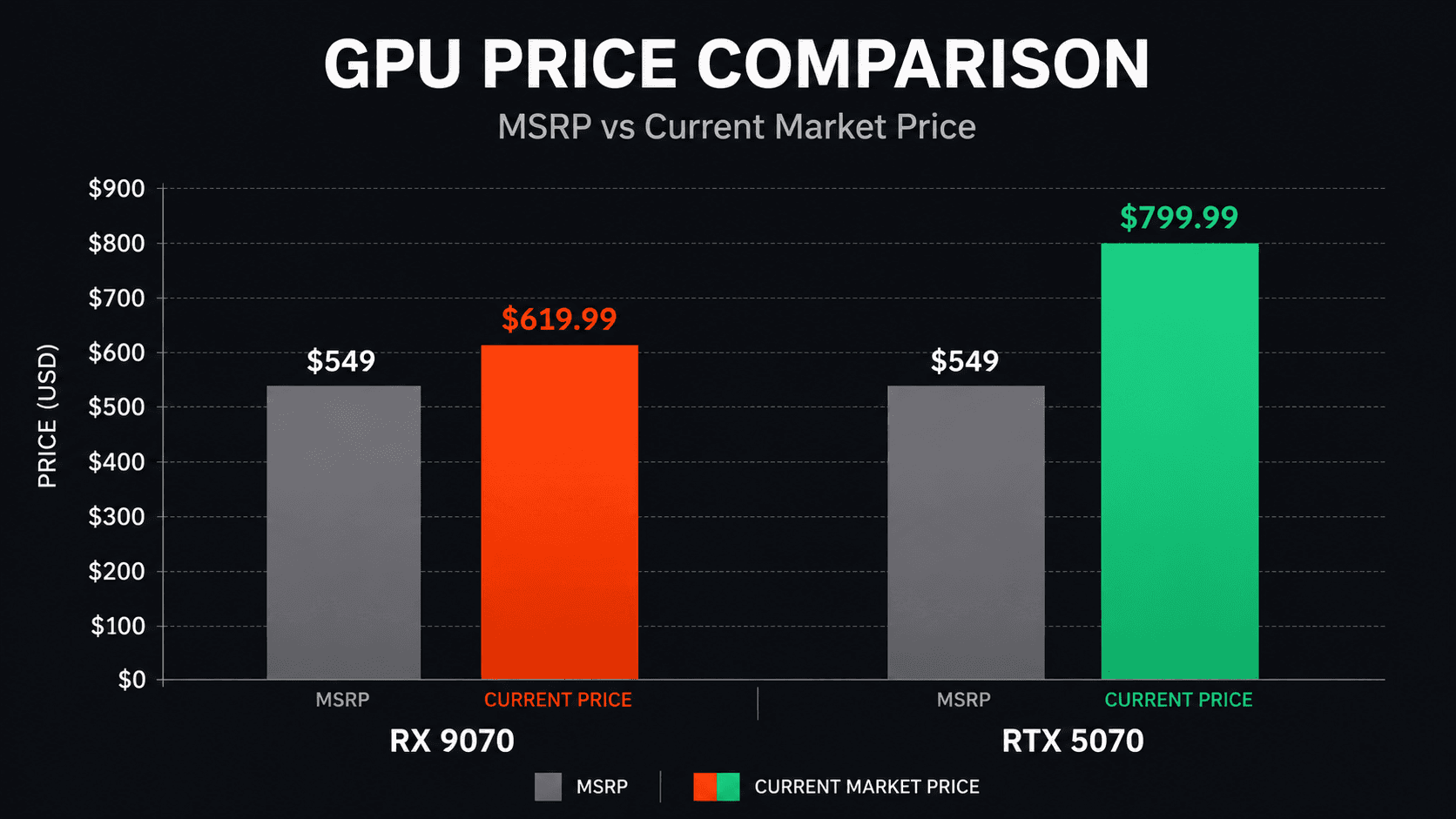
Both cards launched at the same $549 MSRP in 2025, and neither is selling anywhere near that number in August 2026, just not in the same direction. The RX 9070 has stayed close to reality: Amazon lists it at $619.99, roughly 13% above MSRP, and eBay's used market backs that up at around $620. Even the pricier board-partner cards run reasonable, with videocardprices.com's tracker showing the GIGABYTE Gaming OC 16G at $739.99, about 24% above MSRP.
The RTX 5070 tells a very different story. Guru3D and Tom's Hardware both confirmed the same figure: Newegg's median RTX 5070 price jumped from around $660 in July 2026 to roughly $900 in August, a 36% increase in a single month, putting the card about 64% above its $549 MSRP. On Amazon, where pricing has been comparatively calmer, it currently sits at $799.99. Either way you slice it, you're looking at $150 to $250 more than the RX 9070 depending on retailer and specific model.
The reason the gap opened specifically this month comes down to memory, not the GPU itself. The RTX 5070 runs GDDR7, and GDDR7 pricing spiked hard in August 2026; the RX 9070 runs GDDR6, which hasn't seen the same spike and has stayed comparatively stable, according to ThePCEnthusiast's breakdown of the 2026 GPU price increases. That's the whole story behind why a card that cost about the same as its rival in July costs $150 to $250 more in August.
Worth saying plainly: this is a snapshot, not a permanent state. Pricing this volatile can shift within weeks in either direction as GDDR7 supply moves. Check current street prices before you buy, particularly on the RTX 5070 side, where the swings have been the sharpest.
3. Benchmark Results: Rasterization vs Ray Tracing
| Metric (1440p) | RX 9070 | RTX 5070 |
|---|---|---|
| Rasterization (23-game avg, native) | 13% faster | Baseline |
| Rasterization at launch (2025) | 4% faster | Baseline |
| 1% lows (23-game avg) | 11% higher | Baseline |
| Ray/path-tracing-heavy titles | Behind | Clear lead |
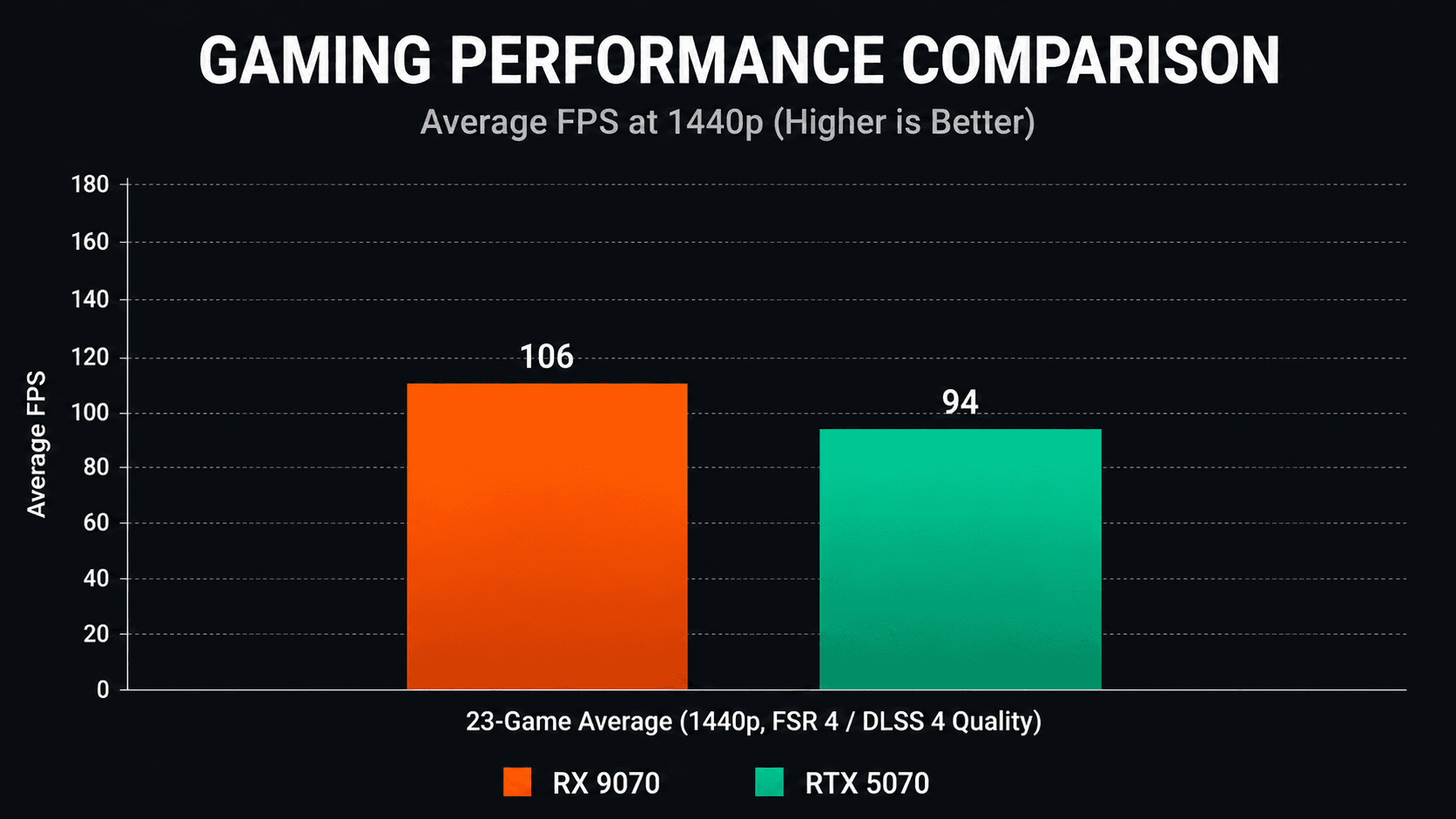
At native 1440p across a 23-game suite on the latest AMD Adrenalin and NVIDIA Game Ready drivers, the RX 9070 runs 13% faster than the RTX 5070 in rasterized games, according to Hardware Unboxed's testing as reported by Notebookcheck. That gap held even with upscaling turned on: the same suite tested with FSR 4 Quality against DLSS 4 Quality still showed the RX 9070 retaining its 13% lead.
What makes that number unusual is the direction it moved. GamersNexus's launch-week review put the RX 9070 ahead by roughly 13% on average at 1440p in its own suite, with a 16% lead in one title, so the gap wasn't new. What's genuinely rare is that Hardware Unboxed's more recent data shows the lead widening from about 4% at launch to 13% now, entirely through AMD driver updates. Post-launch, AMD-versus-NVIDIA rasterization gaps in this GPU generation typically narrow or stay flat as both companies optimize their drivers; this one went the other way.
The RX 9070 isn't just posting a higher average frame rate either. Across the same 23-title set, it averages 11% higher 1% lows than the RTX 5070, according to Noobfeed's testing. That's a measure of frame delivery consistency, not just peak throughput, and it means the RX 9070's advantage shows up as smoother frame pacing, not just a bigger number on the average-FPS chart.
Ray tracing is where the picture reverses. The RTX 5070 has a clear, consistent advantage in ray-traced and path-traced titles. [VERIFY: hard percentage figure for RTX 5070's ray/path-tracing lead over RX 9070 in a specific title, from GamersNexus/Hardware Unboxed/TechSpot] Until that figure is confirmed against a named review, the honest summary is that the RT gap runs meaningfully in NVIDIA's favor, not a rounding error you can ignore if RT-heavy titles are a regular part of your library.
4. VRAM and Power Considerations
The RX 9070 carries 16GB of GDDR6 on a 256-bit bus at 576 GB/s. The RTX 5070 carries 12GB of GDDR7 on a 192-bit bus at 672 GB/s, faster memory but a smaller pool. At 1440p in normal rasterized gaming today, both amounts are fine, neither card is running into a VRAM wall in the games most people play right now. The practical difference is headroom: the extra 4GB on the RX 9070 matters more for texture-heavy titles and for how comfortably either card ages over the next few years as VRAM budgets creep up.
That said, GamersNexus has documented a real limitation with the RTX 5070's 12GB buffer, showing it filling progressively across repeated benchmark passes. The important context is where that happens: it's most pronounced at 4K with ray tracing pushed hard, not in typical 1440p rasterized gaming. Treat it as a headroom caveat worth knowing about, not evidence that 12GB struggles at 1440p today.
Power draw and connectors are where the two cards diverge more clearly. The RX 9070 has an official TGP of 220W and typically uses two 8-pin connectors, depending on the AIB model. The RTX 5070 is rated at 250W and uses NVIDIA's 16-pin 12V-2x6 connector. Recommended PSU wattage runs 650 to 850W for the RX 9070 and 650 to 750W for the RTX 5070, depending on the specific card, so the range isn't identical across every AIB model within either lineup. Before you buy either card, it's worth checking your power supply against the exact model you're considering, not just the GPU name. Our PSU checklist for GPU upgrades walks through the wattage and connector check card by card.
5. Who Should Buy Which
Buy the RX 9070 if you play mostly rasterized or competitive titles, want the better price-to-performance right now, or are upgrading from a card that's three to four years old and want the maximum FPS gain per dollar. At $619.99 against $799.99 for the RTX 5070, you're getting the faster card in the games most people actually play, more VRAM headroom, and smoother frame pacing, all for $150 to $250 less. For most 1440p upgraders, this is the whole decision.
Buy the RTX 5070 if you play ray-traced or path-traced AAA titles regularly, if DLSS 4 Multi Frame Generation is something you'll actually use, or if you're already deep in NVIDIA's software ecosystem, streaming through NVENC or relying on CUDA-based creator tools. Those are real, specific advantages the RX 9070 doesn't match, and if any of them describes how you actually use a GPU, the premium buys something genuine.
What I'd talk you out of: don't buy the RTX 5070 purely out of brand habit at its current price premium. Paying $150 to $250 more for a card that's slower in rasterized games, carries less VRAM, and only wins on features you might not use isn't a safe default choice this month, it's a specific bet that only pays off if you actually use ray tracing or NVIDIA's software stack.
6. The Verdict
For most people upgrading a three-to-four-year-old card for 1440p gaming right now, the RX 9070 is the better buy. It's the faster card in the games most people actually play, it has more VRAM headroom, and this month it costs $150 to $250 less at street price than the RTX 5070. The RTX 5070 is the right pick specifically if you play ray-tracing- or path-tracing-heavy titles often or want DLSS 4 Multi Frame Generation, otherwise you're paying a real premium for features you may not use.
Treat every price in this article as a snapshot from late August 2026, not a fixed number. The RTX 5070's premium over the RX 9070 could shift within weeks as GDDR7 pricing moves, so check current street prices before you buy either card.
If your budget has more room and you want to see how the tier above this one compares, the RTX 5070 Ti vs RX 9070 XT comparison covers the same decision one step up. If you'd rather see the full tiered picture instead of a single head-to-head, the best GPU for 1440p gaming guide breaks down every budget tier with current benchmarks and prices.
Frequently Asked Questions
Is the RX 9070 better than the RTX 5070 for 1440p gaming?
For rasterized gaming, yes, the RX 9070 runs about 13% faster on average across a 23-game suite at 1440p, and that lead has grown since launch through driver updates. It also has 16GB of VRAM versus the RTX 5070's 12GB. The RTX 5070 pulls ahead specifically in ray-tracing and path-tracing-heavy titles, so the "better" card depends on what you play.
Why is the RTX 5070 so much more expensive than the RX 9070 right now?
The RTX 5070 uses GDDR7 memory, which spiked in price during August 2026, pushing the card's street price up 36% in a single month to a median around $900. The RX 9070 uses GDDR6, which hasn't seen the same spike, so it's stayed much closer to its $549 MSRP at around $620. This gap is tied to memory pricing, not a permanent difference between the cards, so it's worth checking current prices before buying.
Does the RX 9070's extra VRAM actually matter for 1440p gaming?
Not dramatically today, both 12GB and 16GB handle current 1440p titles fine in normal rasterized gaming. The extra 4GB on the RX 9070 matters more as a headroom buffer for texture-heavy titles and ray-tracing-heavy scenarios at higher settings, where GamersNexus has documented the RTX 5070's 12GB buffer filling up during extended benchmark runs.
Is the RTX 5070 still worth buying if you care about ray tracing?
If ray tracing or path tracing is a priority in the games you play, the RTX 5070 has a real, consistent advantage there, plus DLSS 4 Multi Frame Generation. The tradeoff is you're paying a significant premium for it at current prices while giving up rasterization performance and VRAM headroom, worth it for RT-focused players, a hard sell for everyone else right now.
What power supply do I need for either card?
Both cards are comfortable on a quality 750W 80 Plus Gold PSU in a typical gaming build. The RX 9070 pulls 220W and usually uses two 8-pin connectors; the RTX 5070 pulls 250W through a single 16-pin (12V-2x6) connector. Specific AIB models sometimes recommend more, so check the exact card's spec sheet before buying.
What to Read Next
- RTX 5070 Ti vs RX 9070 XT → For readers with more budget who want to see how the tier above this one compares.
- Best GPU for 1440p Gaming in 2026 → For readers who want the full tiered buying guide instead of a single head-to-head.