Should You Upgrade Your PC Now, or Wait Out the RAM Shortage?The 2026 memory crisis isn't a normal price cycle — here's how to actually decide.
I quoted a client 32GB of DDR5 for their build in April. By the time they approved the budget three weeks later, the same kit had gone up $80. That's not a one-off — it's been happening on nearly every build I've spec'd since the start of this year, and it's the reason I stopped telling people to “wait for a sale” on RAM.
This isn't a normal price cycle you can wait out with a little patience. RAM and SSD pricing is being reshaped by AI data centers buying up memory production capacity, and every industry source I've read is saying some version of the same thing: this gets worse before it gets better. But that doesn't mean panic-buying everything in sight is the right response either. Below is the actual data, what it means for your specific situation, and where the line is between a smart purchase and a wasted one.
What This Guide Covers
1. The Direct Answer
If you need RAM for a system you're actively building or using, buy it now. Kingston's Cameron Crandall put it plainly: prices won't be cheaper in 30 days. Lexar's regional manager Xia said the same thing from a different company — buy now, meaningful relief is years away. Team Group's general manager described the pricing crisis as having “only just started.” Three competing memory manufacturers are not going to coordinate on the same talking point unless it reflects what they're actually seeing in their own supply chains.
But this isn't a “buy everything” panic. GPUs and CPUs are only mildly touched by this — some GPU price increases of up to $15 on 8GB cards and $30 on 16GB cards have been tied directly to rising DRAM costs on the boards themselves, according to an Overclockers UK supplier notice reported by PC Gamer. That's a minor knock-on effect, not a parallel crisis. Treat this as a RAM-and-SSD-specific timing decision, not a reason to rethink your GPU or CPU upgrade plans.
Buy exactly what you need. 32GB DDR5-6000 is still the sweet spot for most builds, and I wouldn't stretch to 64GB right now just because prices might climb further — that's speculating with your upgrade budget, not solving a problem you actually have. The rest of this article is the why and the how: why this shortage is structurally different from past RAM price cycles, what the numbers actually look like, and how to apply all of it to your specific situation.
2. Why RAM Prices Exploded in 2026
Here's the short version: the same memory chip factories that make the DDR5 in your PC also make the HBM (High Bandwidth Memory) that AI data centers need for training and running large models. Meta, Google, Microsoft, and Amazon have locked in long-term supply contracts with Samsung, SK Hynix, and Micron for that HBM capacity — and when a hyperscaler signs a multi-year contract worth billions of dollars, the factory prioritizes that production line over the consumer DDR5 kit sitting on a Newegg shelf.
The scale of that shift is the part that surprised me. Data centers are projected to consume roughly 70% of all memory chips manufactured in 2026, according to IDC data cited by tech-insider.org. As recently as 2022, that number was around 20–30%. That's not a temporary reallocation — it's a structural rewrite of who the memory industry actually serves, with consumer PCs now competing for what's left over.
The clearest concrete signal of how seriously manufacturers are taking this: Micron exited its own consumer Crucial brand in February 2026 to focus entirely on enterprise AI memory. That's one of the largest memory manufacturers in the world deciding that selling RAM kits to PC builders like you and me is no longer worth the factory space compared to selling HBM to AI companies. When a company walks away from an entire consumer product line, that tells you more about where this is headed than any single price chart does.
3. The Data: How Bad It's Actually Gotten
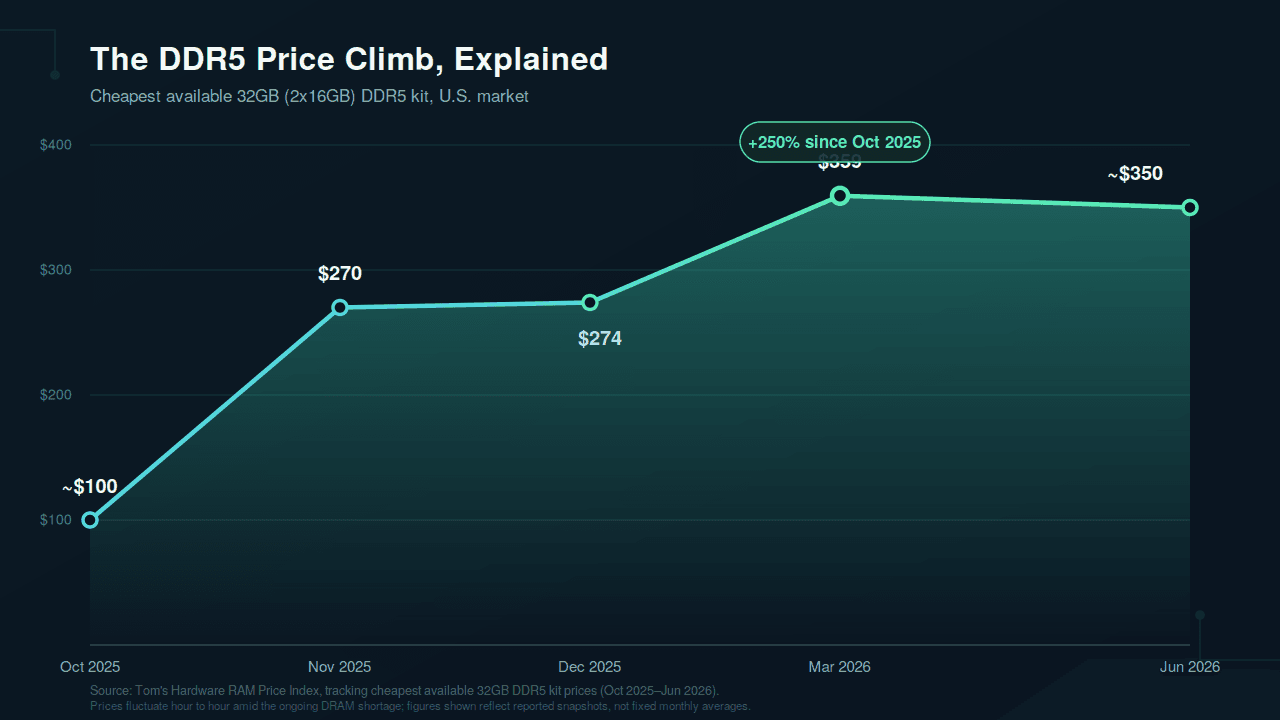
A 32GB DDR5-6000 kit that cost $80–$120 in October 2025 is now listed at a cheapest price of roughly $339, according to Tom's Hardware's RAM price tracker. A 64GB DDR5 kit runs around $680 per Tom's Hardware's pricing coverage. That $339 figure held up when I checked current listings at time of publish: PCPartPicker's cheapest 32GB DDR5-6000 kit is sitting at $349.99, with promo codes occasionally dropping it closer to $299.99, while Newegg's standard retail price runs $389.99–$399.99 (down to $339–$359 with active seasonal promo codes). The pricing isn't just retail markup either — it traces straight back to the manufacturers. Samsung's own 32GB DDR5 module contract price jumped from $149 to $239 within a matter of months, according to rampricesusa.com. That's the price Samsung charges its own customers, not a retailer's margin.
The quarterly numbers explain why this feels so sudden. TrendForce reported that DRAM contract prices surged 90–95% quarter-over-quarter in Q1 2026 — the largest single-quarter increase on record. Counterpoint Research separately measured an 80–90% quarter-over-quarter rise from Q4 2025 into Q1 2026. Those aren't small corrections. A price that roughly doubles in three months is a market that has fundamentally broken from its normal supply-demand rhythm.
If you're thinking DDR4 is a safe harbor because it's older technology, it isn't. A 32GB DDR4 kit that cost $60–$90 in October 2025 was running $150–$180 by January 2026, per Tom's Hardware — roughly double in three months, tracking right alongside DDR5. There's no cheaper, unaffected memory generation to fall back on here. The shortage is upstream of the DDR generation entirely — it's a wafer and fab capacity problem, and every consumer memory product is competing for the same shrinking slice.
4. When Will This Actually End?
Not soon. Analyst consensus puts meaningful relief no earlier than late 2027, with some estimates stretching to 2028, according to TechTimes. Micron's new fab in Idaho — one of the facilities expected to add meaningful consumer DRAM capacity back to the market — won't be operational until the end of 2027 at the earliest, per Windows Central's reporting. On the far end of the range, SK Hynix has cited a possible 2030 timeline for the constraint to fully resolve.
The forecasts for how much worse it gets before then vary, and I want to be upfront about which ones I trust. Gartner projects DRAM and SSD prices could surge up to 130% by the end of 2026 compared to 2025 levels, pushing overall PC prices up roughly 17%. Jefferies' analyst forecast is the most aggressive I've seen — a further 40–50% hike in Q3 2026 and another 30–40% in Q4 2026 — while Aletheia Capital, quoted in the same TechRadar piece, predicts a milder 30% then 15% path. I'd weight my planning toward the middle of that range rather than the Jefferies extreme; single-analyst forecasts that far outside the consensus are worth taking with a grain of salt, even when they turn out directionally correct. What all of these agree on, though, is the direction — up, not down, through the rest of this year.
There is one easing signal worth mentioning: DDR4 spot prices fell 5% recently, the first decline in nearly a year, according to Tom's Hardware. I wouldn't read much into it. A single 5% dip after a year of near-vertical increases is noise, not a trend reversal — especially set against IDC's projection that global PC shipments could fall 10.4–11.3% in 2026 as buyers get priced out entirely. Demand destruction from high prices can produce small, temporary dips like this without changing the underlying supply picture at all.
5. If You're Building a New PC Right Now
If you're on AM5 or LGA1851 and actually building, DDR5-6000 CL30 is still the value sweet spot I'd recommend without hesitation — the pricing crisis hasn't changed which speed tier makes sense, only what you'll pay for it. Buy it now if the build is actually happening. Every quarter you wait based on the forecasts above is a quarter where the kit gets more expensive, not less.
The best lever available right now to blunt the price hit is a bundle deal — RAM packaged together with a CPU or motherboard purchase. Tom's Hardware covered a deal offering 32GB of DDR5 for $126 when paired with a Ryzen 9 9850X3D, which is a meaningful discount off the standalone kit price. If you're assembling a full parts list anyway, checking for RAM-inclusive bundles before buying the memory separately is worth the extra ten minutes of searching.
What I wouldn't do is jump to 64GB “for future-proofing” at today's prices. A 64GB kit running around $680 versus a 32GB kit at roughly half that is a huge incremental cost for capacity most builds simply won't use. Future-proofing against a price increase you're speculating about isn't a good reason to double your RAM spend today — buy the capacity your actual workload needs and revisit the decision later if your needs genuinely change.
6. If You're Upgrading an Existing PC
If you're on AM4 or LGA1700 with DDR4, grab remaining stock now rather than waiting. No new consumer DDR4 production is coming — Micron's exit from the Crucial brand is part of that broader pullback — which means the DDR4 kits available today are drawing down from a fixed, shrinking pool. That $150–$180 price for 32GB DDR4 stings compared to $60–$90 in October 2025, but it's not going to get cheaper while supply keeps shrinking.
If your current RAM is genuinely enough for what you actually do day to day, don't upgrade capacity just because prices might rise further. That's optimizing for a hypothetical future problem instead of a real current one, and it's the exact mistake this shortage tempts people into. Check whether you're actually RAM-constrained before spending anything — if Task Manager shows you comfortably under 80% utilization during normal use, more RAM at these prices isn't solving a problem you have.
GPU and CPU upgrades on these platforms are still reasonable calls — don't let RAM panic bleed into decisions about parts that aren't in crisis. AMD SVP Rahul Tikoo has downplayed the disruption on the CPU side specifically, noting that consumers still have a wide assortment of choice across every price point. I know this is a genuinely frustrating time to be mid-upgrade — watching a component you need double in price while you're trying to plan a budget is not a fun position to be in — but the frustration is specific to RAM and SSDs, not your whole build.
7. What NOT to Do
Don't buy one stick now and plan to add a second one later. It comes up constantly as a workaround for the price spike, but mismatched kits — different batches, timings, or even the same model bought months apart — risk instability, as builders have been warning each other about in threads like this one on the PC Gamer forums. If you need 32GB, buy the matched 32GB kit in one purchase rather than trying to spread the cost across two separate orders.
Watch for fake “discounts” and counterfeit kits
Some of what looks like a RAM sale right now is a retailer clearing old, lower-cost inventory before repricing it higher — not a real trend reversal, according to Tom's Hardware. Separately, TechTimes and Tom's Hardware have both reported counterfeit DDR5 modules circulating — empty chips relabeled to look legitimate — as scarcity creates an opening for bad actors. Buy from reputable, established sellers only, and be skeptical of a price that looks meaningfully better than everywhere else.
Circling back to where this started: if you need RAM for a build that's actually happening, buy it now — the data and every manufacturer quoted above point the same direction. If you don't have a genuine need, don't let the shortage talk you into buying capacity you don't use yet. The mistake in either direction is letting fear of a future price move drive a purchase decision that isn't grounded in what your system needs today.
Frequently Asked Questions
Will RAM prices in 2026 ever go back to normal?
Not this year, and probably not next year either. Analyst estimates for meaningful relief range from late 2027 to as late as 2030, since the shortage is driven by AI data centers permanently absorbing a much larger share of global memory production, not a temporary supply hiccup. Don't plan your upgrade timeline around a price crash — plan around what you actually need today.
Should I buy DDR4 instead of DDR5 right now to save money?
Only if your current platform (AM4 or older Intel) already uses DDR4 — DDR4 has gone up too (roughly double since late 2025), and no new consumer DDR4 is being manufactured, so remaining stock is a depleting resource. If you're on AM5 or a current Intel platform, you don't have a DDR4 option anyway — DDR5-6000 CL30 is still your best value tier.
Is it worth waiting for a sale before buying RAM?
Be careful here — some of what looks like a “sale” is actually a retailer clearing old inventory before repricing higher, not a real trend reversal. Bundle deals (RAM packaged with a CPU or motherboard) are currently a more reliable way to get below-market pricing than waiting for a standalone RAM sale.
Are GPU and CPU prices affected by the RAM shortage too?
A little, but nowhere near as much as RAM and SSDs. Some GPU price increases of $15–$30 have been tied directly to rising DRAM costs on the cards themselves, but that's a minor knock-on effect, not a parallel crisis. Your GPU and CPU upgrade decisions shouldn't really change because of this.
Should I buy more RAM than I need right now, just in case prices go higher later?
I wouldn't. Buying 64GB when you only need 32GB to hedge against future price increases is speculating with your upgrade budget. Buy what your actual workload needs now, and treat any extra capacity as a decision for whenever you genuinely need it.
What to Read Next
- How Much RAM Do You Need in 2026? → For readers who landed here from a pricing angle but still need to figure out capacity — 8GB through 64GB, tier by tier.
- Should You Upgrade Your RAM? → Once you've decided to buy, the full compatibility checklist — DDR4 vs DDR5, slot count, dual-channel pairing, and XMP/EXPO setup.
- Is 16GB RAM Enough for Gaming in 2026? → For readers deciding between capacities under budget pressure — when 16GB still holds up and when it doesn't.
- Is Building an AM4 PC Worth It in 2026 to Dodge the DDR5 Price Crisis? → If you're specifically weighing a DDR4/AM4 build to sidestep this shortage, this breaks down the real dollar savings and the platform dead-end tradeoff.
- SSD Shortage 2026: Buy Now or Wait? → The same NAND-vs-DRAM capacity fight, playing out in storage — with the quarterly data on whether the worst has already passed.