Are GPU Prices About to Rise Because of the RAM Shortage?The short answer: they already are, and 16GB+ cards are taking the biggest hit.
Back in November 2025, a UK retailer put out a warning that felt almost like clickbait: GPU prices going up $15 on 8GB cards and $30 on 16GB cards because of a RAM shortage. I remember reading it and thinking, thirty bucks, that's noise, not a trend. Eight months later I've watched that thirty-dollar warning turn into board partners quietly raising RX 9070 XT prices by nearly $150, and the RTX 5070 Ti trading close to what the RTX 5080 used to cost. The warning wasn't clickbait. It was an undersell.
This isn't a story about one card getting more expensive. It's a pattern that shows up across both AMD and Nvidia's current lineup, tracks cleanly with how much VRAM a card carries, and traces back to the same DRAM supply crunch that's already made system RAM painful to buy in 2026. Here's exactly what the data shows, what it costs you in real dollars, and what to actually do if you're shopping right now.
What This Guide Covers
1. The Direct Answer
Yes. GPU prices are going up because of the RAM shortage, and the DRAM crisis you've read about for system memory has spilled directly into graphics card pricing. In November 2025, Overclockers UK told PC Gamer that "these price increases are now starting to impact graphics card [prices] with up to $15 price increases on 8G cards and up to $30 price increased on 16G cards... NOW IS THE TIME TO BUY your GPU, as 2026 will see price increases." Nine months later, that $30 figure looks conservative. TrendForce has since tracked 15-20% price increases specifically on RTX 50-series cards carrying 16GB of VRAM or more — and several individual cards have moved well past even that percentage.
The pattern is consistent and it isn't subtle: 16GB+ cards have absorbed the bulk of the damage, while 8GB cards have mostly held near MSRP. The RTX 5060 (8GB, $299 MSRP) is still selling for $299-339 — barely moved. Meanwhile the RTX 5070 Ti (16GB, $749 MSRP) is trading anywhere from $900 to $1,300, and the RX 9070 XT (16GB, $599 MSRP) is averaging $689-780. If you need a 16GB+ card, the increase isn't a rumor you're waiting to see confirmed — it's already priced into the listing you're looking at.
2. The Data: What the Price Tracking Actually Shows
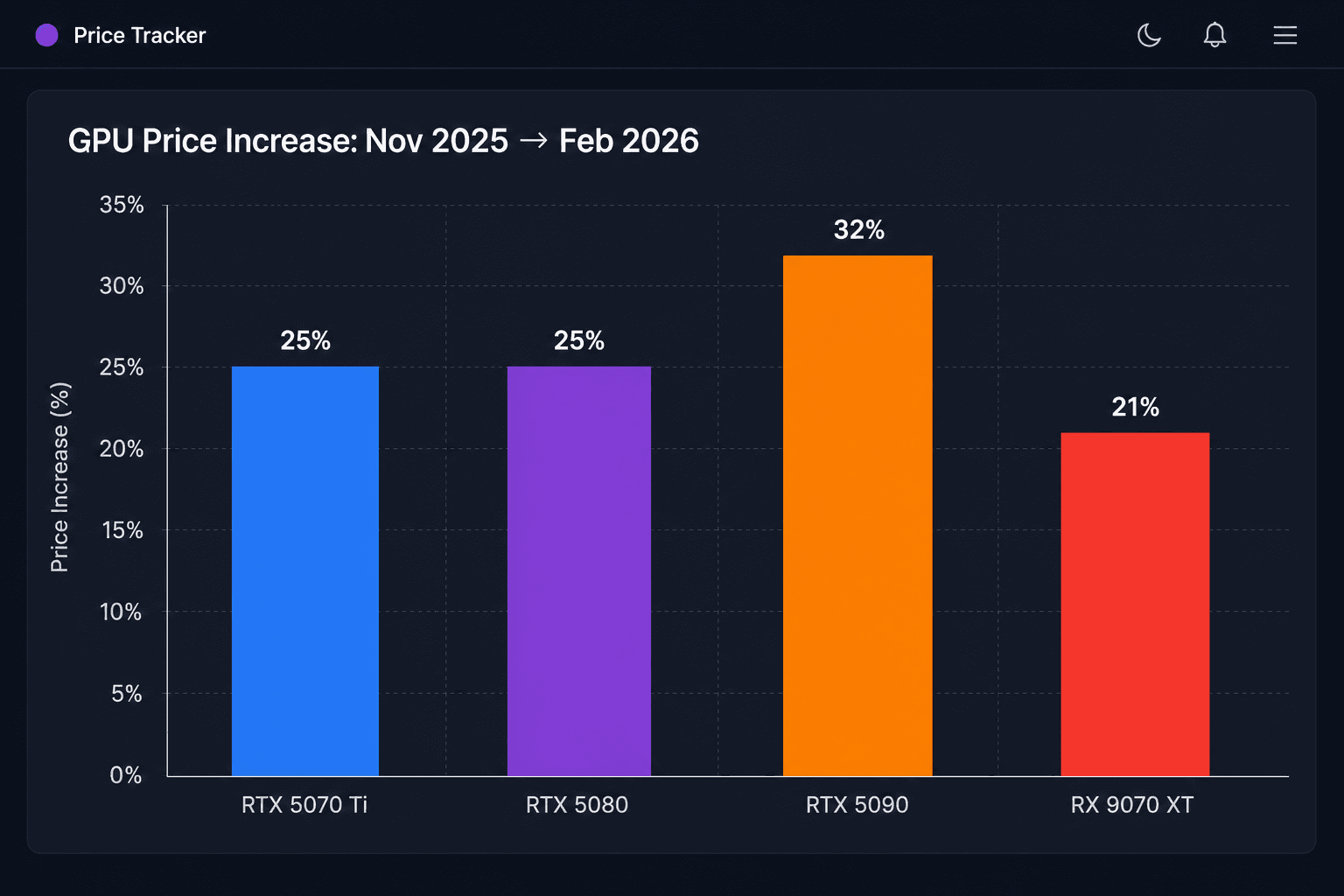
Based on Hardware Unboxed's Nov 2025–Feb 2026 pricing analysis (US market). Later in this post: how prices have moved since.
Hardware Unboxed's price tracking across a 10-region US market average tells the story in hard numbers. From November 2025 to February 2026: the RTX 5070 Ti rose 25% to roughly $1,000, the RTX 5080 rose 25% to roughly $1,400, the RTX 5090 rose 32% to roughly $3,500, and the RX 9070 XT rose 21% to roughly $700. Those aren't projections — that's three months of tracked retail data, and every single one of those cards carries 16GB of VRAM or more.
You can see the same trend at the SKU level. PC Game Check documented the ASUS Prime RX 9070 XT OC going from $799.99 to $939.99 — a 17.5% jump — while the ASUS TUF Gaming RX 9070 XT climbed from $849.99 to $989.99. These aren't obscure boutique cards. They're mainstream AIB models that were sitting on shelves at their original prices a few months ago.
The clearest sign the pricing ladder is breaking down is the RTX 5070 Ti. At its $749 MSRP, it was a clean step below the $999 RTX 5080. Today, according to Best Value GPU's price tracker, it's averaging roughly $919-1,099 depending on retailer — and at times matching or exceeding the RTX 5080's own $999 MSRP. A card that was supposed to be the value pick in the 16GB tier is now priced like the tier above it.
3. How Much It Matters
Percentages are easy to skim past. Dollar amounts aren't. The ASUS Prime RX 9070 XT OC moving from $799.99 to $939.99 is $140 out of your pocket for the exact same card. The ASUS TUF Gaming RX 9070 XT moving from $849.99 to $989.99 is $140 as well. If you were budgeting around the launch price eight months ago and you go to check out today, you're short by the cost of a decent monitor.
The mechanism behind it is straightforward once you see it laid out. Board partners like Sapphire, ASUS, XFX, and Vastarmor don't buy a GPU die and VRAM chips separately — they buy them as a bundled kit from AMD or Nvidia, then build, box, and price the card. When the cost of that bundle goes up, the partner has three choices: eat the cost, cut into their own margin or promotions, or pass it straight to the retail price. According to TrendForce, AMD raised its GPU-and-GDDR bundle kit price to board partners by roughly 10%, effective July 2026 — on top of an earlier increase reported at roughly $10 per 8GB of VRAM, meaning a 16GB card absorbs about a $20 bump on that earlier hike alone, before the July increase is even factored in.
I've been watching Newegg and Amazon listings move week to week while writing this, and it doesn't look like a single price hike event — it looks like a slow ratchet, where a model sits at a new price for a few weeks, dips slightly during a sale, then settles a little higher than where it started. That said, the bundle price hike isn't a guaranteed 1:1 pass-through to what you pay. Hardware Busters reported that partners were warned of the increase, but nothing forces a partner to raise the sticker price by the exact same percentage — they could just as easily trim their own promotions, hold a slower-selling model steady, or absorb part of the cost rather than spook demand that's already soft. In practice, the data above shows most of it is landing on you anyway.
4. When the Answer Changes
If you only need 8GB — 1080p gaming, esports titles, nothing VRAM-heavy — the pressure on you is much lower. The RTX 5060 has barely moved off its $299 MSRP, sitting at $299-339 across Amazon, Walmart, B&H, and Newegg. Vendors are actively prioritizing 8GB and 12GB SKU allocation over the scarcer, pricier 16GB+ tier, which is exactly why that segment has stayed calm while everything above it hasn't.
The reason I don't expect this to reverse on its own timeline is structural, not seasonal. Samsung, SK Hynix, and Micron control more than 95% of global DRAM output, and all three are diverting wafer capacity toward HBM for AI datacenter memory instead of consumer GDDR and DDR. That's not a factory hiccup — it's a deliberate reallocation of manufacturing capacity toward the more profitable product, and it's why there's no RTX 50 Super refresh planned in 2026: adding more VRAM to a card is uneconomical while memory itself is the bottleneck.
IDC projects 2026 DRAM supply growth of just 16% year-over-year and NAND growth of 17%, both well below historical norms — and Lenovo, Dell, HP, Acer, and ASUS have all separately confirmed 15-20% cost hikes flowing through their own products as a result. My honest read on the timeline: this isn't a six-month blip. Relief isn't realistic before 2027 at the earliest, and most analysts don't expect prices to fully revert even once the acute shortage eases — the AI demand driving it isn't going away.
5. What to Do If You're Shopping for a 16GB+ Card Right Now
My verdict hasn't changed since the direct answer at the top of this article: if you need a 16GB+ card, buy now. The shortage is structural, not a temporary spike waiting to correct itself, and every week you wait is a week the pricing ladder gets more distorted, not less.
Among the mainstream 12-16GB cards, the RTX 5070 has moved the least — $599-609 against a $549 MSRP, with the ASUS Prime listed at $609.99 on Newegg and $599 on Amazon. That's still a reasonable buy if you're set on it; the gap is real but small relative to what's happened elsewhere in the stack. If the RX 9070 XT is your actual target, don't wait for a pullback — it's averaging $689-780 against its $599 MSRP, and nothing in the current supply picture points toward that gap closing.
If you can genuinely live with 8GB, the RTX 5060 at $299-339 has barely moved and buys you real time — you're not fighting the same clock the 16GB buyers are. And if you want 16GB without eating the worst of the price pain, the RX 9060 XT 16GB at roughly $399-419 against its $349 MSRP is the least-damaged 16GB option on the market right now — it's still up, but nowhere near the RTX 5070 Ti's territory. Tom's Hardware found four different AIB models sitting at $399.99 on Newegg with promo codes applied, which is about as close to a bright spot as this market currently has.
Frequently Asked Questions
Is the RAM shortage really the reason GPU prices are going up?
Yes. Board partners buy GPU dies and VRAM as a bundle from AMD and Nvidia, and both companies have raised what they charge for that bundle because GDDR and DRAM costs have spiked. AMD's own board partners were notified of a roughly 10% bundle price increase effective July 2026, on top of an earlier hike. That cost either gets absorbed by the partner or passed to you at retail — and the data shows most of it is being passed through.
Which GPUs are affected the most?
Cards with 16GB of VRAM or more. Memory makes up a bigger share of the total bill of materials on those cards, so a DRAM price spike hits them harder in dollar terms. TrendForce tracked 15-20% price increases specifically on 16GB+ RTX 50-series cards, and even the budget-tier RX 9060 XT 16GB is up 14-40% from its $349 MSRP.
Should I wait for prices to come down before buying a GPU?
No, not if you need a 16GB+ card. The shortage is structural — three companies control the vast majority of global DRAM supply and are diverting production toward AI memory instead of consumer GDDR — and most forecasts don't expect real relief until 2027 at the earliest. Waiting is more likely to cost you more, not less.
Are 8GB cards a safer bet right now?
Yes, meaningfully so. The RTX 5060 is still selling within about $40 of its $299 MSRP, while every 16GB card in this article has moved well past its launch price. Vendors are prioritizing 8GB SKU allocation precisely because that's the segment they can still supply affordably.
Will GPU prices go back to normal once the RAM shortage ends?
Probably not fully. Most analysts expect memory prices to remain structurally higher even after the acute shortage eases, since the AI-driven demand for DRAM and HBM isn't viewed as temporary. Treat current pricing as closer to a new baseline than a spike that reverses.
What to Read Next
- Is 16GB RAM Enough for Gaming in 2026? → If you're wondering whether you even need a 16GB-class GPU in the first place, this covers when 16GB system RAM holds up and when it doesn't.
- RTX 5070 Ti vs RX 9070 XT → If you've decided to buy now, this head-to-head verdict covers the two most price-affected cards in this article.
- Best GPU for 1440p Gaming in 2026 → If you're still deciding whether you need 16GB+ at all for your resolution, this breaks down every budget tier with current street prices.
- Should You Buy a Used GPU Instead of New in 2026? → Used prices haven't followed new-card prices up — this breaks down exactly how wide that gap has gotten and when it's worth buying used instead.