Is Building an AM4 PC Worth It in 2026 to Dodge the DDR5 Price Crisis?AMD just relaunched the 5800X3D as a direct answer to $400 RAM kits. Here's who should actually take them up on it.
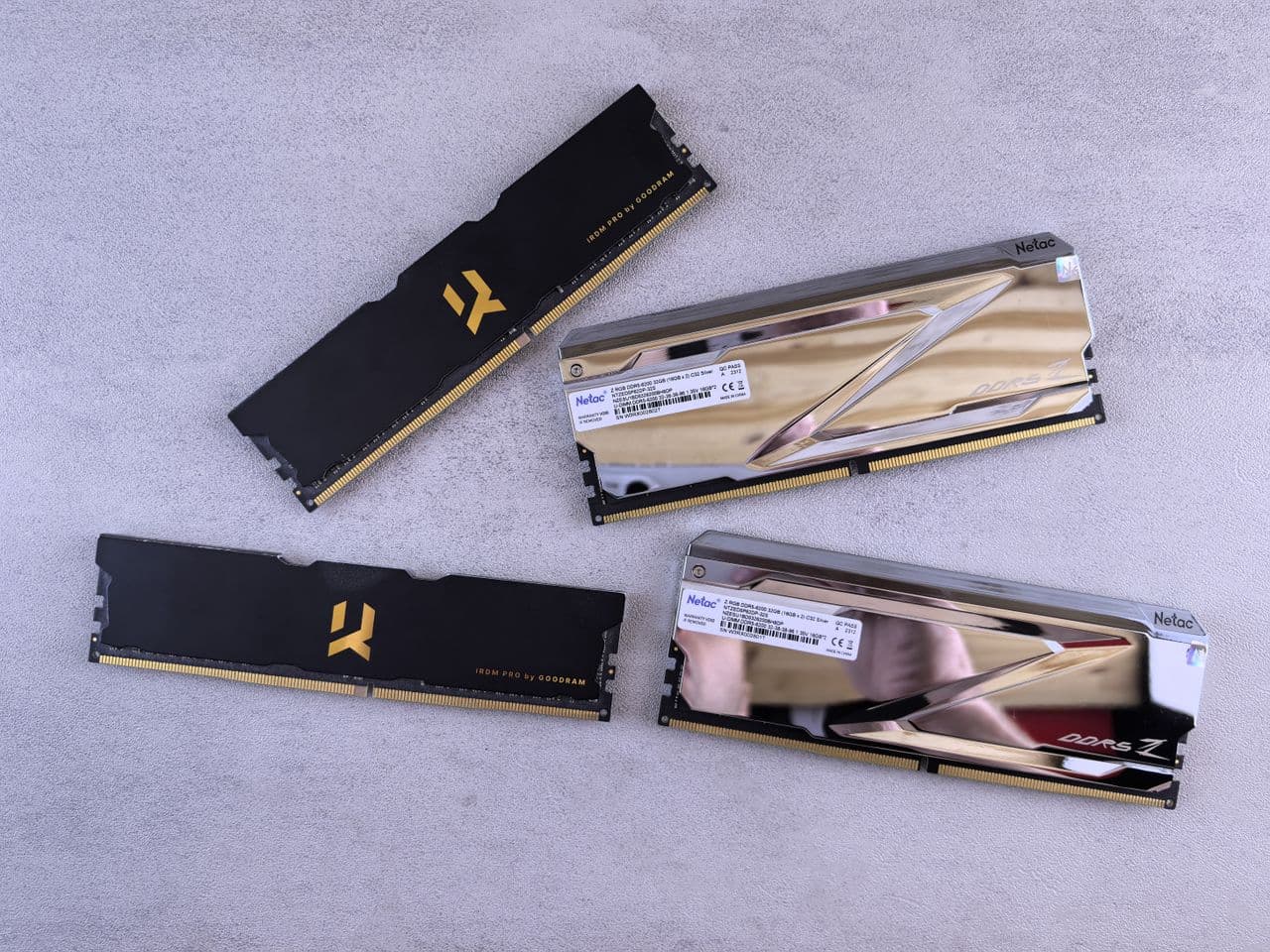
I priced out a 32GB DDR5 kit last week and it was $520. Then I found the DDR4 version of basically the same spec for $240. That $280 gap used to be enough to make me tell everyone building a new PC in 2026 to just go grab an old AM4 board and call it a day. Then I actually ran the math on a full build, not just the RAM, and the answer got a lot more complicated than “buy AM4, save money.”
AMD didn't leave this to chance either. The company just re-released the Ryzen 7 5800X3D — a five-year-old chip — as its own official answer to the DDR5 shortage, at the same $349 price point Newegg's scalper listings were charging $600-800 for a few months earlier. That's the real news here, not the RAM prices alone. Below is what building AM4 in 2026 actually costs once you price the whole platform, not just the memory kit, and exactly who should take AMD up on this and who shouldn't.
What This Guide Covers
1. Is AM4 Still Worth Building In 2026?
If you already own an AM4 motherboard, dropping in a 5800X3D for $349 is the easiest yes in PC building right now — no RAM, no board, no compatibility roulette. If you're building from scratch, AM4 still saves you real money on RAM ($240 DDR4 vs $395+ DDR5), but it's a dead-end platform buying you maybe two more years, not a long-term move. If you already bought DDR4 hoping to “wait out” AM5, you've locked yourself into upgrading a platform that has nowhere left to go.
AMD isn't being subtle about why the 5800X3D 10th Anniversary Edition exists. At Computex 2026, the company publicly billed the relaunch as a direct answer to crisis-priced DDR5 memory, branding it the “return of the king,” according to TechTimes. That's not nostalgia marketing — it's AMD acknowledging that a huge chunk of its own customer base can't afford a DDR5 platform right now and giving them a path that doesn't require one.
The timing makes the comparison unavoidable. The 5800X3D went on sale June 25, 2026 at $349 on AM4. The Ryzen 7 7700X3D launches July 16, 2026 at $329 on AM5. Same price bracket, three-week window, two completely different platforms with two completely different memory requirements. That near-simultaneous launch is the actual decision point this article is built around — not just “RAM is expensive,” which every outlet has already covered.
Everything below splits into three groups with three different right answers: people who already own an AM4 board, people building a PC from nothing, and people who already bought DDR4 hoping to dodge this decision entirely. Sections 5 and 7 cover those three groups directly.
2. What CPUs Actually Work On AM4 Right Now (The Real Ceiling)
A B550 or X570 board with a current BIOS supports the full Ryzen 5000 lineup, topping out at the 5800X3D — 8 cores, 16 threads, 4.5GHz boost, 96MB of L3 cache (100MB combined with the CPU's own cache), on a 105W TDP. Older A520, B450, and X470 boards support it too, but almost all of them need a BIOS update first, since it launched years after those chipsets did. That update is a five-minute job on a board that already has a compatible CPU installed, and a genuine hassle on one that doesn't — flash it before you buy, not after.
For board picks specifically, Tom's Hardware's B550 motherboard roundup is the reference I'd check before buying — it's where the Asus ROG Strix B550-F Gaming Wi-Fi pricing used later in this article comes from. The 5700X3D sits below the 5800X3D as the mid-tier CPU option if you don't need the full 96MB cache, and the Ryzen 5 5500 is the floor — the last genuinely new budget CPU AMD sells on this socket, a 6-core chip with no integrated graphics. There isn't a cheaper new option below it, and there won't be one coming. Gigabyte released four new AM4 boards in January 2026 — two A520, two B550 — explicitly citing DDR5-driven AM4 demand as the reason, and MSI followed with two new B550 microATX boards on February 27, framed around keeping DDR4 builds alive for existing Ryzen 5000 owners. Motherboard makers are still supporting this socket. AMD itself isn't adding new silicon above the 5800X3D.
That's not a flaw, it's just where the ceiling sits. Whatever CPU you buy on AM4 today — 5500, 5700X3D, or 5800X3D — is the final upgrade that socket will ever get from AMD. There's no Zen 6 coming to AM4. Buy accordingly.
3. What Building AM4 In 2026 Locks You Into
Before the numbers get exciting, here's the honest cost of going this route. AM4 has no DDR5 support, ever — the 5800X3D's official memory spec is DDR4-3200, and even AMD's own April 2026 testing pushed it only to DDR4-3600. There's no PCIe 5.0 either; you're capped at PCIe 4.0 for your GPU and storage. And there's no CPU above the 5800X3D coming, ever, as covered in the last section. This isn't a stepping stone to a future upgrade. It's the finish line for the platform.
AM4 in 2026 is a purchase with no sequel
Every other platform decision on this site assumes you might upgrade a single component later. AM4 doesn't work that way anymore. The 5800X3D is the last CPU the socket will ever get. Budget for a full platform swap — motherboard, CPU, and RAM together — whenever you eventually outgrow it.
You're not without an alternative dead-end path, either. Tom's Hardware separately tested a full DDR4-based Intel build around the i5-14600KF on LGA1700 — $1,262.84 total, saving at least $200 versus an equivalent DDR5 build. It's the same trade AM4 is making, just on the Intel side: real savings today, in exchange for a platform that isn't going anywhere either. I mention it because if you're not already invested in AMD, it's worth knowing this isn't an AMD-exclusive strategy — it's a whole category of “buy the last generation that still supports DDR4” builds.
4. The Actual Numbers: AM4+DDR4 vs AM5+DDR5 Right Now
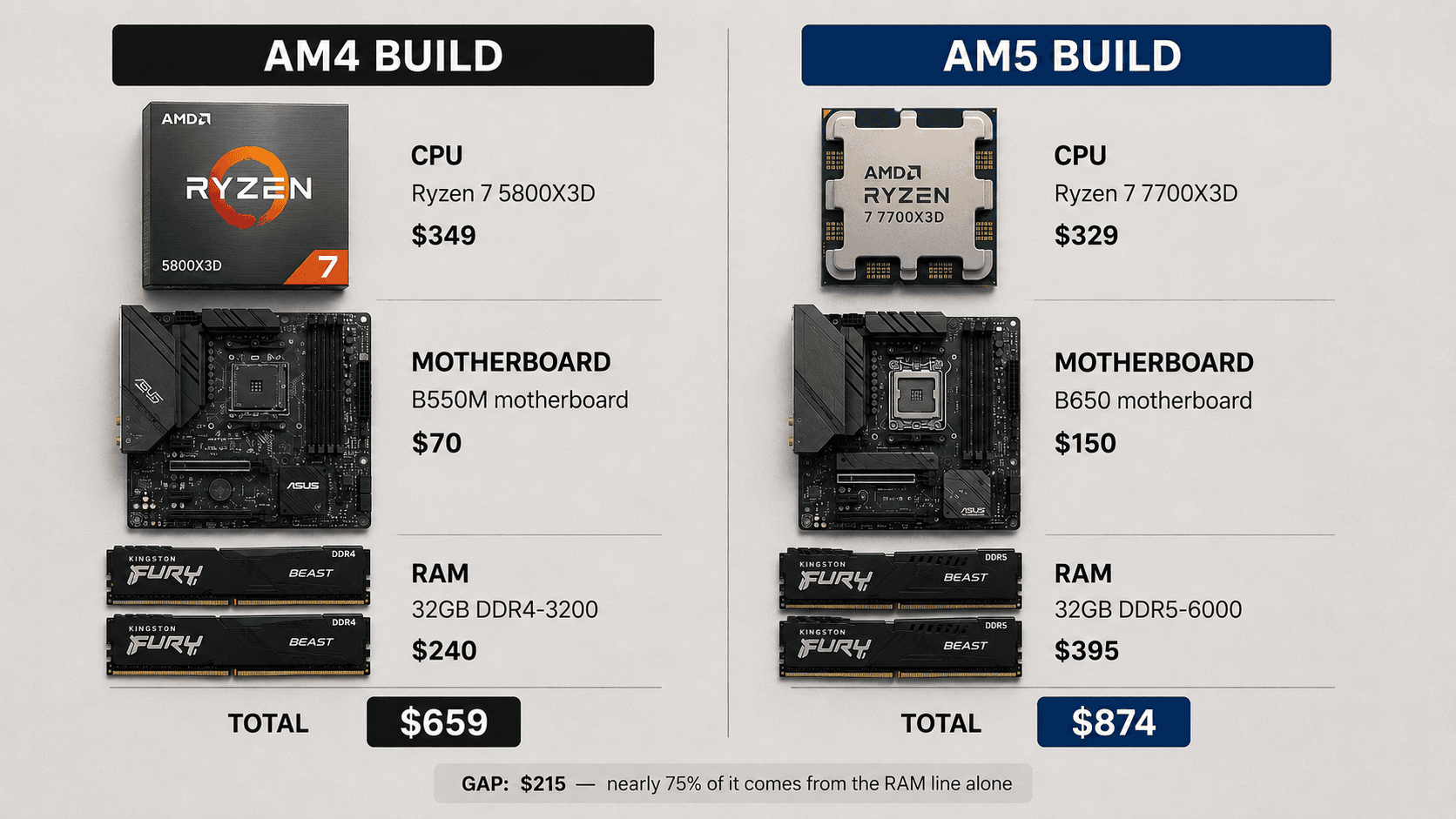
Here's the build-out that actually matters, using live Newegg listings checked July 6, 2026, not shortage-headline numbers. AM4: a Ryzen 7 5800X3D at $349, an ASRock B550M-HDV budget board at $70, and a 32GB (2x16GB) DDR4-3200 kit — the cheapest being Team T-Force Vulcan Z at $239.99. That's $658.99 total. AM5: a Ryzen 7 7700X3D at $329, a budget B650 board at $149.99, and a 32GB (2x16GB) DDR5-6000 kit — the cheapest being Patriot Viper Venom at $394.99. That's $873.98 total.
The gap is $214.99 — real money, but not the $394.99-vs-$239.99 RAM headline gap you'd assume from the shortage coverage alone. The reason it shrinks: the CPUs are close, and the 7700X3D is actually $20 cheaper than the 5800X3D. The motherboards aren't the story either — a budget B550 board and a budget B650 board land close enough in the same tier that neither platform wins meaningfully there. Almost the entire $214.99 gap comes from one line item: the RAM. DDR5 32GB costs $155 more than DDR4 32GB at the cheapest listings on each side, and that single number accounts for nearly 75% of the total platform difference.
If you want a nicer board, the Asus ROG Strix B550-F Gaming Wi-Fi runs under $240 on the AM4 side. That's a real upgrade in build quality and features, but it also erases most of the platform-level savings if you go that route — which is exactly why I'd frame this as a RAM decision more than a platform decision. State it plainly: for a from-scratch build in 2026, AM4 saves you roughly $150-200 total. It does not save you $300 or more, no matter how dramatic the DDR5 shortage headlines read.
5. Who Should Actually Build AM4 Right Now
Restating the verdict from Section 1, now with the numbers behind it: if you already own an AM4 board, the 5800X3D is the easiest yes in PC building right now. If you're building from scratch, AM4 saves real money but buys you two more years on a platform that's already at its ceiling, not a long-term move. If you already bought DDR4 to wait out AM5, you've made the platform decision without meaning to.
Group 1: you already own an AM4 board with anything older than a Ryzen 5000-series CPU installed. Buy the 5800X3D for $349 flat and drop it in. No RAM purchase, no motherboard purchase, no research required. This is the clearest upgrade decision covered anywhere on this site right now — you're not building a platform, you're finishing one you already own.
Group 2: you're building from scratch and genuinely budget-constrained. AM4+DDR4 saves you $150-200 in real dollars, per the math in the last section — acceptable if you go in accepting the dead-end tradeoff from Section 3. GamersNexus's “$668 Cheap Bastard's” build from January 2026 — a Ryzen 5 5500 paired with that same B550M-HDV board — proves this works at the true bottom of the budget scale. If you've got a bit more to spend, Tom's Hardware's $1,262.84 DDR4-based Intel build shows the same logic holds up a full tier higher too. One caveat worth knowing before you buy the CPU specifically: Tom's Hardware's own 5800X3D re-review calls the $349 price “$70 to $100 too expensive” for anyone not already invested in AM4 — worth keeping in mind if you're pricing the CPU and board together rather than dropping it into hardware you already own.
If neither of those describes you — you don't already own AM4, and you're not tightly budget-constrained — keep reading, because Section 6 is the honest counter-case.
6. When AM5 Makes More Sense Even With DDR5 This Expensive
If you plan to keep this system four or more years, lean AM5. That's the entire calculus. AM4 has already hit its ceiling at the 5800X3D — there is no future CPU coming, as covered in Section 2. AM5 doesn't have that problem yet, and it still has DDR5 headroom to grow into as memory speeds and capacities improve over the platform's life.
The CPU cost argument for AM4 barely exists anymore, either. The 7700X3D launches at $329 — $20 cheaper than the $349 5800X3D. If you're choosing based on which chip costs less, AM5 wins that specific line item outright. The only dollars AM4 saves you now live in the RAM line, not the CPU line.
And if you're banking on DDR5 getting cheaper soon enough to make waiting worthwhile — it isn't, not on any timeline that matters for a build happening this year. Analyst forecasts point to no meaningful relief through 2026, with the earliest credible normalization window sitting in late 2027. If you can stretch to AM5 today, you're not really waiting out anything by choosing AM4 instead — you're just deferring the DDR5 purchase to a platform that won't have anywhere left to grow when you finally make it. For the full breakdown of exactly who should make the jump now versus later, I covered the whole AM4-to-AM5 decision in more depth in Should You Upgrade from AM4 to AM5 in 2026?
7. Common Mistakes People Are Making With This Decision Right Now
The mistake I keep seeing in comment sections and forums: buying DDR4 as a stopgap while “waiting for AM5 to get cheaper,” then realizing months later that they've now committed to a platform with nowhere left to go. That decision felt like patience at the time. It was actually the opposite — it locked the reader into the exact dead-end tradeoff covered in Section 3, without the person ever consciously choosing it.
Don't buy DDR4 as a “temporary” fix
If you buy AM4+DDR4 assuming you'll switch to AM5 once prices drop, you've already made the platform decision — you just haven't admitted it yet. There is no cheap on-ramp from AM4 to AM5 later; it's a full motherboard, CPU, and RAM replacement either way, so you may as well make it a deliberate choice now instead of a default you back into.
The second mistake is assuming DDR5 prices crash soon. They won't — most analyst forecasts point to late 2027 at the earliest for meaningful relief, as covered in Section 6, and I've gone deeper into the full pricing timeline and the manufacturer quotes behind it in Should You Upgrade Your PC Now, or Wait Out the RAM Shortage? Planning a build around a price crash that's over a year out, at minimum, isn't a strategy — it's a delay with a hopeful label on it.
The third mistake is the one that's now actually solved: chasing a scalped 5800X3D. Before the official relaunch, resale listings on eBay were running $600-800 for a chip AMD now sells new for $349. If you were tempted to pay scalper prices for this exact CPU a few months ago, the wait was worth it — buy it at retail now instead.
Frequently Asked Questions
Is it worth buying a new AM4 motherboard in 2026 just to avoid DDR5 prices?
Only if you're budget-constrained on a from-scratch build and accept that AM4 has no further upgrade path. You'll save roughly $150-200 versus an equivalent AM5+DDR5 build, mostly from RAM alone. If you can afford the extra $150-200, AM5 is the better long-term platform since it isn't at its ceiling yet.
Is the Ryzen 7 5800X3D still worth it in 2026?
Yes, if you already own an AM4 board — at $349 with no other purchases required, it's one of the easiest upgrade decisions available right now. It's a weaker case if you're buying a motherboard and RAM alongside it, since Tom's Hardware's own testing calls the standalone price $70-100 too high for that scenario.
Should I buy the Ryzen 7 5800X3D or wait for the Ryzen 7 7700X3D?
The 7700X3D costs $20 less ($329 vs $349) and sits on a platform with an actual future, so if you're building new, it's the safer buy. The only reason to choose the 5800X3D is if you already own AM4 hardware and want to avoid a DDR5 purchase entirely.
How much does DDR4 actually save you over DDR5 right now?
Based on live pricing, a 32GB DDR4-3200 kit runs about $240 versus roughly $395-520 for a comparable 32GB DDR5-6000 kit — a real savings of $150-280 depending on which kits you compare. It's a meaningful gap, but smaller than some shortage headlines suggest.
When will DDR5 prices come back down?
Analyst forecasts from Gartner and TrendForce point to no meaningful relief through 2026, with the earliest credible window for normalization in late 2027. If you need a PC now, budgeting for current prices is more realistic than waiting.
What to Read Next
- Should You Upgrade from AM4 to AM5 in 2026? → The full platform-switch breakdown for existing AM4 owners, including the same-socket 5800X3D upgrade path versus a full move to AM5.
- Moving to AM5? 9800X3D vs 9950X3D → If you make the jump to AM5, this is the X3D decision you'll face next, and how to avoid overpaying for cores you won't use.
- Best GPU for 1440p Gaming in 2026 → Once you've settled the platform question, this covers which card actually fits an AM4-tier budget.
- Is 16GB RAM Enough for Gaming in 2026? → For deciding on RAM capacity once you've picked DDR4 or DDR5 — before you commit to the full 32GB kit price in this article.
- Intel's DDR4 CPU vs. AM4: which platform has more runway → The direct sibling comparison — how AM4 stacks up against Intel's rumored DDR4-friendly LGA1700 chips for long-term platform survival.