RTX 5060 Ti vs RX 9060 XTA 6% performance gap. A $240 price gap. Here's who should still pay it.
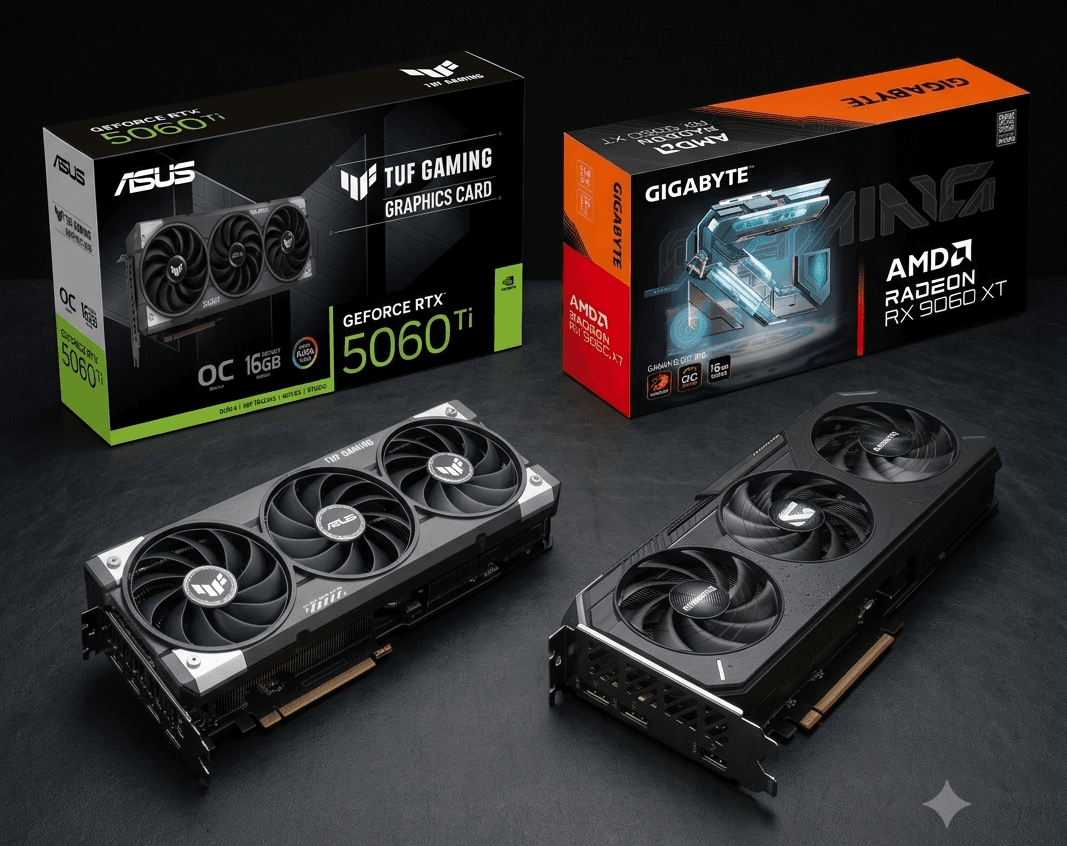
I've watched people spend $240 more on a GPU that benchmarks 6% faster, then run it at 1440p ultra where the cheaper card actually wins because it has the VRAM to stay in the fight. That's what's happening with the RTX 5060 Ti and the RX 9060 XT right now. The reviews are out. The prices are real: on PCPartPicker's lowest in-stock listings (October 25, 2026), the RX 9060 XT 16GB is $529.00 and the RTX 5060 Ti 16GB is $765.99. And the comparison is messier than the headline numbers make it look — not because it's close, but because which card actually wins depends on a question most people don't think to ask first: what does your VRAM slot say when you're actually playing games?
Both cards launched within two months of each other in 2025, and both are now selling far above launch price — the RX 9060 XT 16GB launched at $349 and the RTX 5060 Ti 16GB at $429, so today's prices are roughly 52% and 79% over. Both come in 8GB and 16GB flavors that perform like genuinely different products. This article is about the 16GB versions — the only sensible pick for 1440p gaming in 2026 — using street prices pulled from PCPartPicker on October 25, 2026, benchmark data from Tom's Hardware, and a 16,000-vote TechPowerUp poll, with a verdict that doesn't hedge.
What This Guide Covers
1. The 30-Second Verdict
My call, stated up front: buy the RX 9060 XT 16GB unless you play ray-traced games heavily or stream on Twitch using Nvidia's encoder. On PCPartPicker's lowest in-stock prices (October 25, 2026), the RX 9060 XT 16GB runs $529.00 — about $237 cheaper than the RTX 5060 Ti 16GB at $765.99. For that $237, you're giving up about 6% of rasterization performance at 1440p: 134 FPS on the 9060 XT versus 142 FPS on the 5060 Ti, averaged across 10 games by Tom's Hardware. That's an 8 FPS difference you won't feel on a 144Hz monitor, and in any title where the 5060 Ti's 8GB variant runs into its VRAM ceiling, that gap disappears or reverses entirely.
The RTX 5060 Ti 16GB earns its premium for one specific buyer: someone who plays ray-traced games as a regular habit — Cyberpunk 2077 with path tracing, Indiana Jones: The Great Circle with RT maxed, Alan Wake 2 — or a streamer who needs DLSS 4 Multi-Frame Generation and Nvidia's 9th-gen NVENC encoder for their workflow. If that's you, the premium buys something real. If it's not, you're paying $237 for a 6% number that won't survive contact with your actual game library.
One more thing before the benchmarks: there are four cards in this comparison, not two. The 8GB versions of both GPUs are a different product entirely — covered in the next section — and this article is specifically about the 16GB models, the only sensible choice for 1440p gaming in 2026.
2. What You're Actually Choosing Between (SKU Reality)
Before any benchmark numbers mean anything, you need to understand that "RTX 5060 Ti vs RX 9060 XT" is actually four products wearing two names. Each GPU ships in an 8GB and a 16GB configuration, and at 1440p in 2026, those aren't memory variants — they're different products with different verdicts.
The RTX 5060 Ti 8GB is the one to be careful with. Tom's Hardware's GPU guide flags it as hitting a VRAM cliff at 1440p ultra in texture-heavy games — the GPU itself has the horsepower, but it runs out of memory before it runs out of frames. If you're buying a 5060 Ti for 1440p gaming in 2026, the 8GB model at $501.99 is not the comparison this article is making — the 16GB model, from $765.99, is.
The RX 9060 XT 8GB is in better shape but still tight. At 1080p high settings it's a perfectly capable card — but at $459.99 on PCPartPicker, only about $70 under the 16GB model, it's a hard one to recommend. At 1440p, Tom's Hardware's review is blunt about it: "Be wary of the 8GB models, which are a completely different ballgame." Same conclusion as the 5060 Ti — fine at 1080p, not the card for 1440p.
This is also where AMD's marketing needs a footnote. AMD's Computex 2025 data — the source behind the widely repeated "9060 XT is 6% faster than the 5060 Ti at 1440p ultra" claim, drawn from a 40-game average — compares the 16GB 9060 XT against the 8GB 5060 Ti. That's not a clean comparison; it's two different VRAM tiers, and the 8GB card's cliff is doing a lot of the work in that 6% number. The honest comparison — 16GB versus 16GB — is the one this article runs, and it tells a closer, more interesting story: a 6% gap in Nvidia's favor, not a 6% reversal.
Everything from here forward is about the 16GB models: RTX 5060 Ti 16GB and RX 9060 XT 16GB. If your budget tops out at $460–$500, you're buying an 8GB card ($459.99 for the 9060 XT, $501.99 for the 5060 Ti) and a 1080p experience — which is a fine trade, just a different one than what's being discussed below.
3. Price Reality Check
Forget MSRP for a second — though we'll get to it. Here's what these cards cost on PCPartPicker as of October 25, 2026. The cheapest RX 9060 XT 16GB is the Asus DUAL at $529.00. The models this guide originally priced have climbed further: the XFX Swift OC is $619.99, the GIGABYTE Gaming OC $649.99 and the XFX Mercury OC Black $679.99. The RTX 5060 Ti 16GB starts at $765.99 (Asus DUAL OC), 79% over its $429 MSRP, and mainstream models run up to about $860. Cheapest to cheapest, that's a $237 gap. At the top of the range it's about $331.
Both prices are well above MSRP, and both are above MSRP for the same reason: Tom's Hardware has been tracking what it describes as the dreaded moment arriving with force — the 2026 GPU supply squeeze driven by AI wafer demand eating into consumer GPU production capacity. The result is a 16GB RTX 5060 Ti at 79% over its $429 MSRP. AMD launched the 16GB 9060 XT at $349 in June 2025; it now sells about 52% above that.
$237 is not a rounding error. It's more than a whole Ryzen 5 7600 costs ($209), and about half the price of a 32GB DDR5 kit right now. The data suggests a lot of buyers already agree with that math. TechPowerUp ran a price-to-performance poll with more than 16,000 votes: the RX 9060 XT took over 8,500 of them, beating the RTX 5060 Ti's roughly 3,500 by a 143% margin. That's not a close vote.
4. Benchmark Results: Rasterization (What Most Games Actually Use)
Here's where the actual numbers live. Tom's Hardware's reporting on the Eteknix benchmark suite ran both 16GB cards across a 10-game average at 1080p and 1440p, high/ultra settings.
At 1080p, the RTX 5060 Ti averages 194 FPS against the RX 9060 XT's 187 FPS — a lead of about 4% for Nvidia. In practice, this is a non-issue. Both cards are pushing well past 144Hz at 1080p in this test suite, and the difference between 187 and 194 FPS is not something you will perceive, on any monitor, in any game. If your build is a 1080p build, this number shouldn't factor into your decision at all.
At 1440p — the resolution this article is actually about — the RTX 5060 Ti averages 142 FPS against the RX 9060 XT's 134 FPS. That's about a 6% lead, or 8 frames per second. Put plainly: you're choosing between 134 FPS and 142 FPS on average. That's not a tier difference. It's not even a noticeable difference on a 144Hz monitor — both cards deliver a smooth, high-refresh 1440p experience, and the 8 FPS gap won't change how either one feels in your hands.
Then there's the wrinkle: HowManyFPS aggregates benchmark data across 100+ games, and its conclusion is that the RTX 5060 Ti is slightly slower than the RX 9060 XT on average across that broader set. That's the opposite of the 10-game numbers above, and the reason is the same VRAM story from Section 2 — a meaningful chunk of that 100+ game dataset includes results from the 8GB 5060 Ti, which hits its VRAM ceiling in enough titles to drag the average down. It's also a signal that, even setting VRAM aside, these two cards are genuinely close — close enough that which one "wins" depends on which subset of games you're measuring.
5. Benchmark Results: Ray Tracing (Where the 5060 Ti Pulls Away)
This is the section where the RTX 5060 Ti earns its keep, and I'm not going to soften it.
Indiana Jones: The Great Circle at 1440p with the Supreme preset forces ray tracing on — it's not optional, the way it is in most games. Tom's Hardware's review and pcbuildhelper.com 's testing both put the RTX 5060 Ti at roughly 56 FPS native in this scenario, against roughly 44 FPS for the RX 9060 XT. That's a 27% lead for Nvidia — and unlike the roughly 6% rasterization gap, this one is a real, felt difference. 56 FPS is a smooth experience. 44 FPS is the edge of choppy, especially in a game with this much camera movement.
The gap compounds further with upscaling. DLSS 4 Multi-Frame Generation is exclusive to Nvidia's Blackwell architecture — which includes the RTX 5060 Ti — and in supported titles it can generate up to three AI frames for every one rendered frame, a 4x total multiplier. Nvidia lists more than 250 supported games and apps (January 2026), including Cyberpunk 2077, Black Myth: Wukong, Alan Wake 2, and Hogwarts Legacy. In Cyberpunk 2077 with path tracing enabled, the RTX 5060 Ti with DLSS 4 MFG can hit 100+ FPS — a setting that would otherwise be a slideshow on hardware in this tier. The RX 9060 XT runs FSR 4, AMD's hardware-accelerated upscaler with 64 AI accelerators. AMD's FSR frame generation on RDNA 4 is 2x only; AMD's software has hinted at higher multipliers (Tom's Hardware, April 2026), but none has been released as of this update. In the same path-traced Cyberpunk scenario, the 9060 XT with FSR 4 trails meaningfully behind the 5060 Ti's DLSS 4 MFG result.
If ray tracing is a regular part of how you play — not a setting you toggle on for a screenshot and then turn back off — this is the section that should decide your purchase. A 27% lead in an RT-mandatory title, plus an upscaling technology that can multiply your frame rate by up to 4x in 250+ games, is a real and recurring advantage every time you launch one of those games. It's the clearest, most defensible reason to pay the RTX 5060 Ti's premium.
6. VRAM, Bandwidth, and Why the 9060 XT Doesn't Fall Apart
Here's a number that should make the RTX 5060 Ti's lead look bigger than it is: the 5060 Ti's GDDR7 memory runs at 28 Gbps over a 128-bit bus, for roughly 448 GB/s of bandwidth. The RX 9060 XT's GDDR6 runs at 20 Gbps over the same 128-bit bus, for roughly 320 GB/s. That's a 40% raw bandwidth advantage for Nvidia. If memory bandwidth translated directly into frame rate, the 5060 Ti should be crushing the 9060 XT, not leading by about 6%.
It doesn't translate directly, and the reason is AMD's 32MB Infinity Cache — a pool of fast on-chip memory that sits between the GPU cores and the GDDR6 VRAM. Think of it like a small, fast pantry next to the stove versus a much bigger pantry down the hall. The 5060 Ti has the bigger pantry down the hall (more raw bandwidth to VRAM), but the 9060 XT keeps the ingredients it reaches for most often in a pantry that's right next to where it's cooking. Most of what a game's rendering pipeline asks for repeatedly — textures, frame buffers, shader data reused frame to frame — gets caught by that 32MB cache before the GPU ever needs to make the trip to GDDR6. The result is an effective bandwidth much higher than the 320 GB/s spec sheet number suggests.
That's why the real-world rasterization gap collapses to about 6% instead of tracking the 40% bandwidth difference. Where the raw bandwidth advantage does show up more clearly is in ray tracing — RT workloads involve more random, less-predictable memory access patterns that are harder for any cache to anticipate, which is part of why the RTX 5060 Ti's RT lead (27% in Indiana Jones) is so much larger than its rasterization lead (about 6% at 1440p). Both cards land in the same place on the spec that actually matters for capacity: 128-bit bus, 16GB of VRAM at this tier. The bandwidth story is a wash for most games and a real Nvidia advantage for ray-traced ones — which is the same conclusion the rest of this article keeps arriving at from different angles.
7. Who Should Buy the RX 9060 XT
You're the right buyer for the RX 9060 XT 16GB if your game library is mostly rasterization — which, for most people, it is. Outside of Cyberpunk 2077 with path tracing, Indiana Jones: The Great Circle with RT maxed, and Alan Wake 2 with full ray tracing, the overwhelming majority of games — competitive shooters, most RPGs, most open-world titles, anything releasing in 2026 that isn't built around RT as its headline feature — run in the rasterization mode where these two cards are within about 6% of each other.
You're gaming at 1440p and care about FPS per dollar above almost everything else. At $529.00 for the cheapest RX 9060 XT 16GB, you're getting 134 FPS average across Tom's Hardware's 10-game 1440p suite for $237 less than the cheapest RTX 5060 Ti 16GB. That's the best price-to-performance ratio in this matchup, full stop — and it's the reason 16,000+ TechPowerUp voters picked the 9060 XT over the 5060 Ti by a 143% margin.
You're on an AM5 platform with a Ryzen 9000 CPU. AMD's Smart Access Memory gives the 9060 XT an extra bit of bandwidth headroom when paired with a Ryzen 9000 chip on AM5 — a small edge, but a free one if you're already on that platform.
You don't rely on Nvidia's NVENC encoder for streaming. If you're not on Twitch, or you're streaming with OBS using software encoding or AMD's AV1 hardware encoder, the 9060 XT's encoder situation isn't a dealbreaker.
And to be specific about which 9060 XT to buy: the 16GB model at $529.00, not the 8GB at $459.99. The roughly $70 difference between those two SKUs is the best money you'll spend in this entire comparison — it's the difference between a 1440p card and a 1080p card wearing the same name.
8. Who Should Buy the RTX 5060 Ti
You're the right buyer for the RTX 5060 Ti 16GB if ray tracing is a habit, not a setting you check once. If Cyberpunk 2077 with path tracing, Indiana Jones: The Great Circle with RT maxed, or Alan Wake 2 with full ray tracing are games you actually play — regularly, with those settings on — the 27% RT lead in Indiana Jones and the DLSS 4 MFG advantage in Cyberpunk are real, recurring benefits every session.
You stream on Twitch or YouTube and rely on NVENC. Nvidia's 9th-generation encoder is a meaningful step up for streaming and Shadowplay-style recording — better quality at the same bitrate, which matters if you're pushing 1080p60 or 1440p to viewers while also gaming.
You want DLSS 4 Multi-Frame Generation specifically. It's a Blackwell-exclusive feature, it's supported in over 250 games and apps (NVIDIA, January 2026), and in the right title it can turn an unplayable path-traced setting into a smooth one. AMD's FSR frame generation on RDNA 4 is 2x only, so there's no 3x or 4x equivalent today. If MFG is something you'll use across a broad library, the 5060 Ti is the safer long-term bet for that specific feature.
You're running a high-refresh 1080p setup — 240Hz or higher — and want the extra competitive headroom. Nvidia Reflex 2 is also part of the package here, aimed at exactly this kind of latency-sensitive setup.
One price caveat, and it's an important one: this only makes sense if you're not paying the top of the range. On PCPartPicker (October 25, 2026) the RTX 5060 Ti 16GB runs from $765.99 to about $860. At $765.99 the premium over the 9060 XT is $237; at about $860 it's about $331. At $237 more I'd only pay it if you specifically want DLSS 4 Multi Frame Generation or heavy ray tracing. If the only 16GB 5060 Ti in stock is near $860, buy the 9060 XT.
9. The Verdict
My call hasn't changed from the top of this article: buy the RX 9060 XT 16GB unless you play ray-traced games heavily or stream on Twitch using Nvidia's encoder. At $529.00 against $765.99 for the RTX 5060 Ti 16GB, you're paying about $237 — roughly 45% more — for a 6% rasterization advantage that's invisible on a 144Hz monitor — and that advantage shrinks or vanishes if you accidentally end up with the 8GB version of either card.
The RTX 5060 Ti 16GB is the right call for the buyer described in the previous section: regular ray tracing, NVENC streaming, DLSS 4 Multi-Frame Generation as a feature you'll actually use. For that buyer, the 27% RT lead in Indiana Jones: The Great Circle and the 250+ game DLSS 4 MFG library are worth real money. But at $765.99, even that buyer should think twice: the 5060 Ti 16GB works out to about $5.39 per average 1440p frame against $3.95 for the 9060 XT, which makes it a hard sell for anyone outside that specific profile.
Prices are also not static, and lately they've moved the wrong way. The RX 9060 XT 16GB launched at $349 and now sits at $529.00; the RTX 5060 Ti 16GB launched at $429 and sits at $765.99. The April-era price trackers that suggested the 5060 Ti would settle back toward its launch price by July didn't pan out. If the 5060 Ti ever comes back within a hundred dollars or so of the 9060 XT, the math in this article gets noticeably closer, and I'd revisit the rasterization numbers before assuming the verdict still holds at full strength.
What's genuinely striking here is how lopsided the trade has become. A 6% rasterization gap against a $237 price difference between two 16GB cards from different vendors is a steep ask outside the profile above. Whichever of these two you end up with, you're buying a card that will serve you well at 1440p in 2026 — the question this article answers is just which one serves you better for what you specifically do with it. And before you order either one, it's worth running through the GPU upgrade compatibility checklist for PSU wattage and case clearance on your specific build.
Frequently Asked Questions
Is the RX 9060 XT 8GB worth buying?
Not for 1440p AAA gaming in 2026, no. The 8GB model is technically capable at 1080p high settings, but 8GB of VRAM is increasingly a constraint in texture-heavy titles — even at 1080p ultra settings in some games. AMD's own marketing compares the 16GB 9060 XT against Nvidia's 8GB 5060 Ti to make the "6% faster" claim, which should tell you something about what AMD thinks of 8GB configurations. If your budget only stretches to $460, the 8GB 9060 XT is fine for 1080p. At only about $70 more, the 16GB 9060 XT is the easy choice for 1440p.
Does the RX 9060 XT support ray tracing?
Yes, it has 32 dedicated hardware RT accelerators built into the RDNA 4 architecture. Performance is solid in titles with optional ray tracing at medium/high RT settings, but it falls roughly 27% behind the RTX 5060 Ti in fully ray-traced workloads like Indiana Jones: The Great Circle at maximum RT settings. If you play games with optional RT at balanced settings, you won't notice. If you play games with RT-mandatory paths at max quality, the gap is real and the 5060 Ti is the better choice.
Will FSR 4 catch up to DLSS 4 Multi-Frame Generation?
AMD's FSR frame generation on RDNA 4 is 2x only. AMD's software has hinted at higher multipliers (Tom's Hardware, April 2026), but none has been released as of this update. DLSS 4 Multi-Frame Generation is supported in over 250 games and apps (NVIDIA, January 2026). FSR 4 is hardware-accelerated on RDNA 4 but relies on game-by-game developer adoption. The gap could close, but DLSS 4 MFG is the more capable technology today in games that support it. If Multi-Frame Generation is a priority, the 5060 Ti is the safer long-term bet for that feature specifically.
How much does the Infinity Cache matter on the RX 9060 XT?
More than most people realize. The 5060 Ti has 40% more raw memory bandwidth (448 GB/s vs 320 GB/s), which sounds like a massive advantage on paper. But AMD's 32MB Infinity Cache acts as an on-chip data buffer, dramatically reducing how often the GPU has to pull from the slower main VRAM pool. In practice, this collapses the bandwidth gap to about 6% in rasterization gaming. Where it doesn't close the gap is in ray tracing workloads, which are more bandwidth-intensive and expose Nvidia's raw bandwidth advantage.
Should I wait for prices to drop before buying either?
Prices on both cards have gone up since launch, not down. The RX 9060 XT 16GB launched at $349 and is $529.00 on PCPartPicker (lowest in stock, October 25, 2026); the RTX 5060 Ti 16GB launched at $429 and is $765.99. The April-era price trackers that expected the 5060 Ti to settle back toward its launch price by July didn't pan out. If you're buying today, the RX 9060 XT 16GB at $529.00 is the value play. If you can wait, nothing in the current numbers suggests the $237 gap is about to close, so waiting only makes sense if you're hoping the 5060 Ti comes back toward its $429 launch price.
Which card is better for a streaming and gaming setup?
The RTX 5060 Ti. Nvidia's 9th-gen NVENC encoder is a genuine step up for streamers — better image quality at lower bitrates, especially relevant if you're streaming at 1080p60 or 1440p on Twitch. The RX 9060 XT has AV1 hardware encoding support and its encoder is capable, but NVENC has the edge in compatibility, streaming software support (OBS, Streamlabs), and quality per bitrate. If gaming performance is all you care about, the 9060 XT wins on value. If you're running a streaming setup, the 5060 Ti is the right choice.
What to Read Next
- Should I Upgrade My GPU? → If you're still deciding whether a GPU upgrade is even the right move for your system before spending on either card.
- Best GPU for 1440p Gaming in 2026 → If you want a broader look at which GPU tier makes the most sense for 1440p gaming at your budget, not just this specific matchup.
- RTX 5070 Ti vs RX 9070 XT → If your budget stretches higher and you want to see how the tier above this one compares.