Ryzen 7 9800X3D vs Ryzen 9 9950X3D: Which X3D Chip Should You Actually Buy?Same gaming performance, very different price. Here's when the 9950X3D's eight extra cores are worth paying for on AM5.
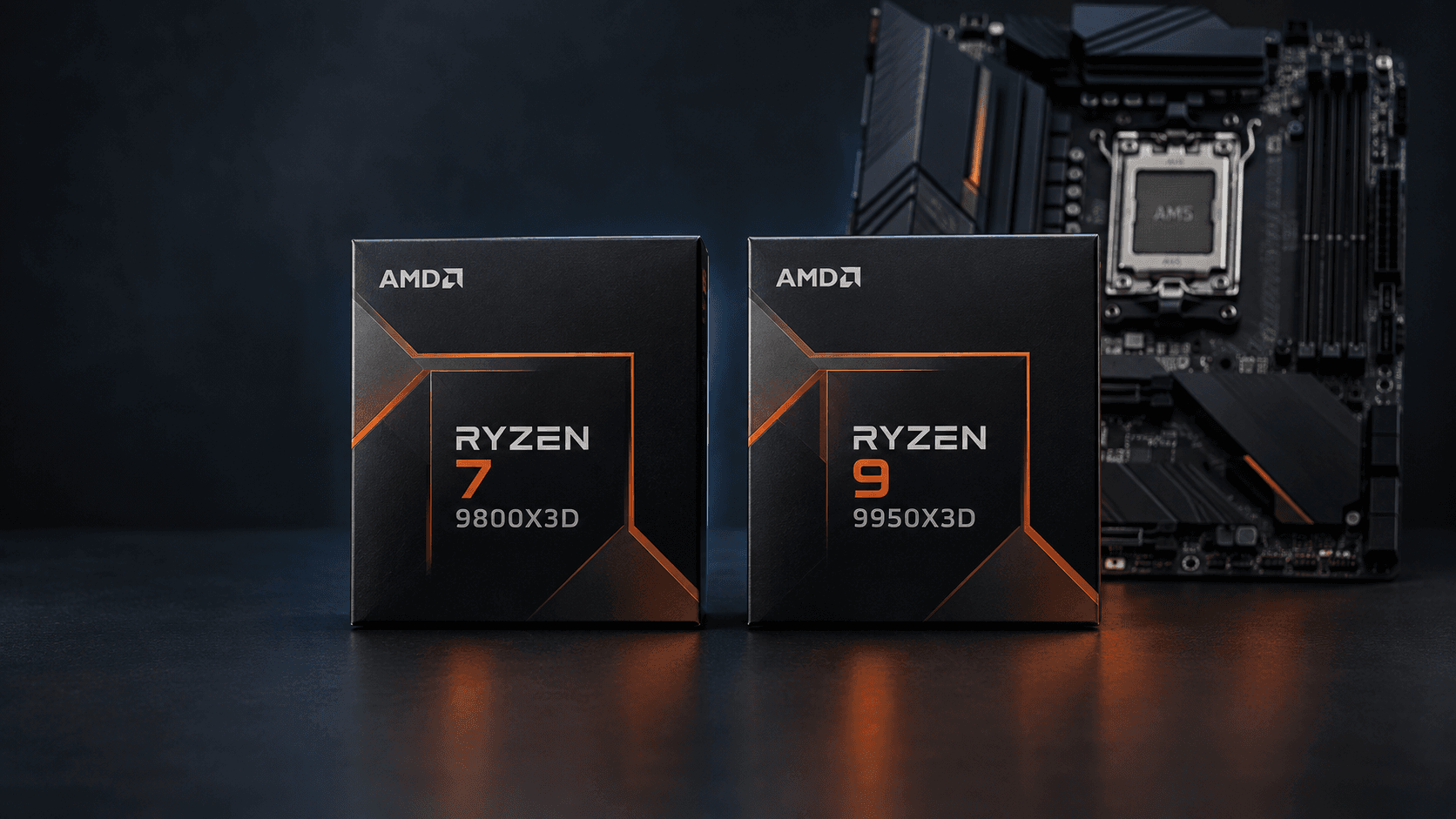
For gaming, the Ryzen 7 9800X3D and Ryzen 9 9950X3D are the same chip: Tom's Hardware measured a 0.4% gap across its 1080p test suite, and TechSpot's 12-game average came out even. So the real question isn't which one is faster. It's whether you'll use eight extra cores often enough to pay about $220 more for them. If you only game, buy the 9800X3D at around $435 and keep the difference, because your AM5 board is confirmed to accept AMD's next-generation Zen 6 chips when they arrive. If you render, compile, or edit video every week, the 9950X3D earns its place, but at today's $658 it's $90 above the $569 it has already sold for, so wait for a coupon if you can.
Both chips carry AMD's 3D V-Cache, both drop into the same AM5 socket, and both are built on Zen 5. The difference is what sits next to the cache. The 9800X3D is a single 8-core, 16-thread die with 96MB of L3 stacked on top. The 9950X3D adds a second 8-core die without the stacked cache, for 16 cores, 32 threads, and 128MB of L3 in total. That second die is where every dollar of the price gap goes, and it only pays you back in workloads that can use all 32 threads at once. This comparison also covers the Ryzen 7 9850X3D and Ryzen 9 9950X3D2, because retailers list them right next to these two and neither is worth your money.
One step before you spend $400 or more on any of these: if you haven't confirmed that your processor is actually what's limiting your frame rate, run through our CPU upgrade bottleneck checks first. A new X3D chip does nothing for a game that's waiting on your graphics card.
What This Guide Covers
1. The 30-Second Verdict
If you only game, or you stream using your graphics card's encoder, buy the Ryzen 7 9800X3D. Its gaming performance is identical to the 9950X3D across three separate outlets (Tom's Hardware, TechSpot, and GamersNexus), and the roughly $220 you save is better spent on your GPU or a future Zen 6 chip for the same AM5 board. Buy the Ryzen 9 9950X3D only if you render, compile code, or edit video every week. Even then, it's at $658 right now, well above the $569 it has sold for with coupons, so wait for a deal unless you need it today. Skip the 9850X3D and the 9950X3D2 entirely.
| If you… | Buy | Why |
|---|---|---|
| Only game | Ryzen 7 9800X3D | Same gaming FPS for about $220 less |
| Game and stream with NVENC or AMF (GPU encoder) | Ryzen 7 9800X3D | The encoding runs on the graphics card, not the CPU |
| Game and render, edit, or compile every week | Ryzen 9 9950X3D | 77% more multi-core performance; wait for $569 to $600 |
| Do heavy productivity work and game lightly | Ryzen 9 9950X (non-X3D) | GamersNexus: about $500 to $520, and the X3D cache adds little to production work |
The rest of this article is the evidence behind that table: where the prices actually sit this week, the benchmark numbers from each outlet, and the specific buyer each chip is built for.
2. Price Reality Check (September 2026)
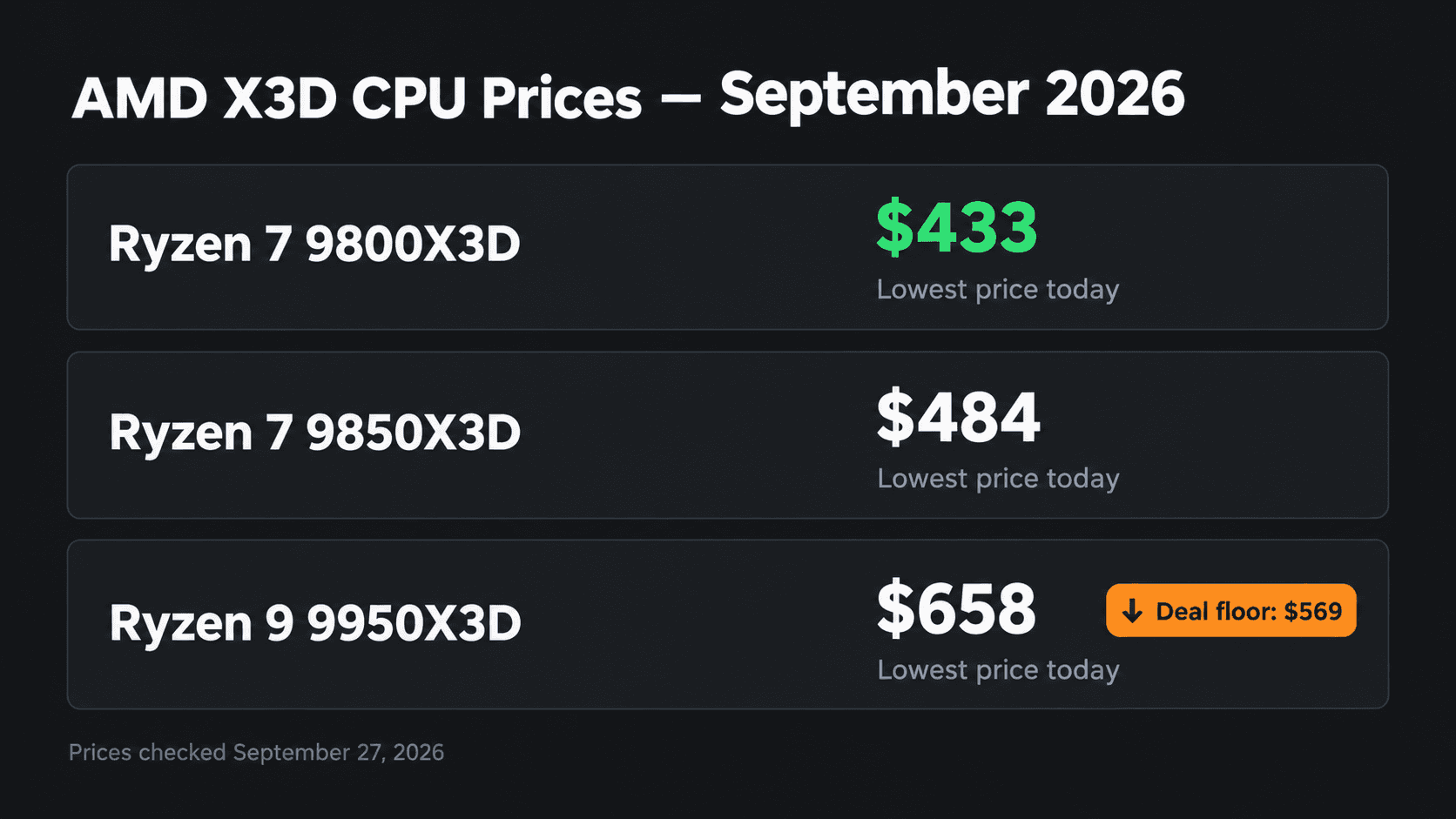
The Ryzen 7 9800X3D is selling for $433 to $439 right now. PC Guide tracked it at $438.94 on Amazon as of September 21, down from its usual $479, and the Pangoly price tracker shows $433, with an all-time low of $419.99 set on May 13, 2026. That's a chip sitting near the bottom of its price history.
The Ryzen 9 9950X3D is not. When I checked PCPartPicker on September 27, its lowest price was $657.95 at Amazon. Newegg, Best Buy, and B&H all listed it at $699.00, Abt had it at $699.99, and no promo codes were live anywhere. Compare that with what it has already sold for this summer: TechPowerUp reported an all-time low of $569 at both Amazon and Newegg in late July, an 18.5% drop from its $699.99 launch price, and Newegg repeated that $569 price on August 19 with promo code BTS21. Two separate $569 events in one summer means that price is not a fluke.
| Chip | Lowest price today | Best deal seen | Retailer |
|---|---|---|---|
| Ryzen 7 9800X3D | $433 to $438.94 | $419.99 (May 13, 2026) | Amazon |
| Ryzen 7 9850X3D | $484.00 | No deal tracked (launched at $499) | Amazon, B&H |
| Ryzen 9 9950X3D | $657.95 | $569 (late July; August 19 with code BTS21) | Amazon today; Amazon and Newegg for the $569 deals |
Sources: PCPartPicker (checked September 27, 2026), PC Guide and Pangoly for the 9800X3D, TechPowerUp for the 9950X3D's $569 low. PCPartPicker's 9850X3D listing shows $499.00 at Newegg, $499.99 at Walmart, and $509.99 at Best Buy above that $484 low.
So the gap between the two chips you're actually choosing between is about $220 at today's prices, and about $130 when the 9950X3D hits its deal price. That difference matters. At $130, the 9950X3D is a reasonable premium for someone who will use the extra cores. At $220, it's paying full price for a chip that has repeatedly sold for less. My buy zone for the 9950X3D is $569 to $600. Above $600, wait unless you have paid work that needs it this month. Set a price alert on its PCPartPicker page so you get an email the moment it drops back into that range, rather than checking manually.
You may see a "buy before AMD raises prices" argument floating around. Don't let it rush you. TrendForce reported on September 18 that AMD has notified multiple customers of increases of roughly 10%, expected in 4Q26, but those reported hikes cover AI accelerator chips, consumer graphics processors, and motherboard chipsets. CPUs are not explicitly mentioned, and AMD had not issued an official statement or press release confirming any increase as of that date. If you already own an AM5 board, a chipset price hike doesn't touch you at all. Buy on price, not on a rumor that doesn't name your product.
3. Gaming Benchmarks: A Dead Heat
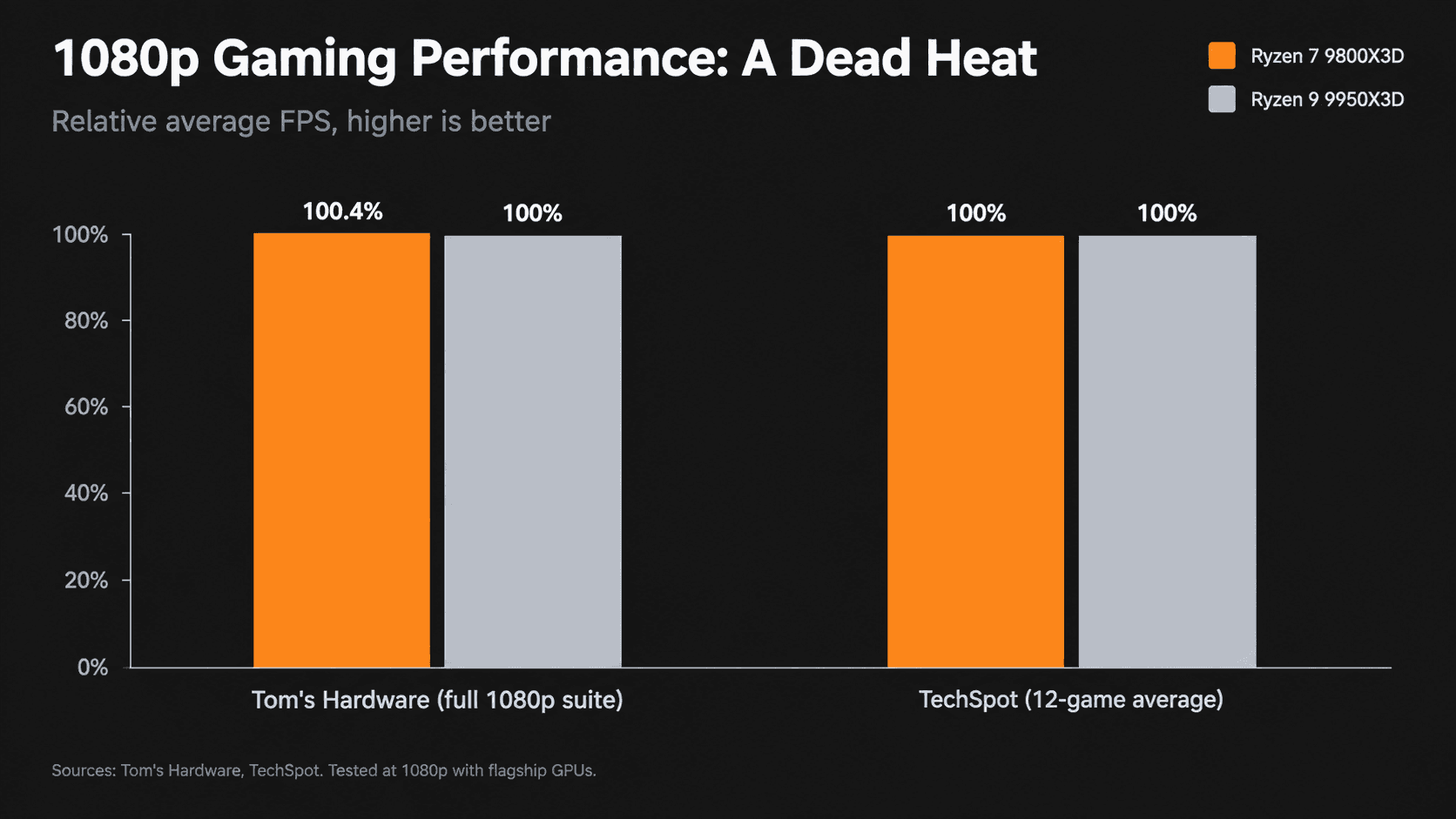
Three outlets, three different test suites, one result. Tom's Hardware found the 9800X3D 0.4% faster than the 9950X3D across its full 1080p gaming suite, which it called a tie, noting that the dual-die chip wins some titles and loses others. TechSpot's 12-game average put the 9950X3D in the top spot, but delivering essentially the same performance as the 9800X3D. GamersNexus measured 380 FPS average for the 9800X3D and 373 FPS for the 9950X3D in Final Fantasy XIV: Dawntrail, a 2% lead it described as functionally equal.
| Test (source) | Ryzen 7 9800X3D | Ryzen 9 9950X3D | Result |
|---|---|---|---|
| 1080p full suite average (Tom's Hardware) | 0.4% faster | Baseline | Tie |
| 1080p 12-game average (TechSpot) | Essentially equal | Top spot, essentially equal | Tie |
| Homeworld 3 (TechSpot) | 4% faster | Baseline | 9800X3D |
| Hitman 3 (TechSpot) | Baseline | 6% faster | 9950X3D |
| FF XIV: Dawntrail (GamersNexus) | 380 FPS avg | 373 FPS avg | 9800X3D by 2% (equal) |
TechSpot's test system: Asus ROG Strix RTX 4090 OC, 32GB DDR5-6000 CL30, Gigabyte X670E Aorus Master, 12 games at 1080p.
Read the per-game rows carefully, because they explain why the averages land where they do. In TechSpot's suite, the spread between the two chips runs from the 9950X3D trailing by 4% in Homeworld 3 to leading by 6% in Hitman 3. That's ordinary title-to-title variation for two chips with the same gaming hardware, and it averages out to nothing. If a specific game you play constantly sits at one end of that range, the difference is still single digits.
The reason the two chips tie is simple. When Windows detects that a game is running, the 9950X3D "parks" the eight cores on its second die, the one without the stacked cache, and makes them temporarily unavailable to the operating system. The game runs entirely on the eight cache-equipped cores. At that point you're gaming on an 8-core X3D processor, which is exactly what the 9800X3D already is. The 9950X3D's higher 5.7 GHz boost clock and extra 32MB of L3 don't translate into a lead because the extra hardware is switched off while you play.
9950X3D owners, keep your chipset driver current: the core parking described above depends on AMD's chipset driver working together with Windows Game Mode, according to TechSpot. The 9950X3D's gaming numbers assume that software is doing its job. Install AMD's latest chipset driver after you drop the chip in, and update it when AMD releases a new one. The 9800X3D has only one die, so it doesn't rely on this at all.
One more point about these numbers: every result above was measured at 1080p with flagship graphics cards. That's deliberate on the reviewers' part, because it's the worst case for exposing CPU differences, and even there the two chips tie. At 1440p and 4K, your graphics card does more of the work per frame and the CPU matters less, so the gap between these two chips shrinks further from an already negligible starting point. No resolution exists where the 9950X3D becomes the better gaming buy.
4. Productivity: Where the Extra 8 Cores Earn Their Money
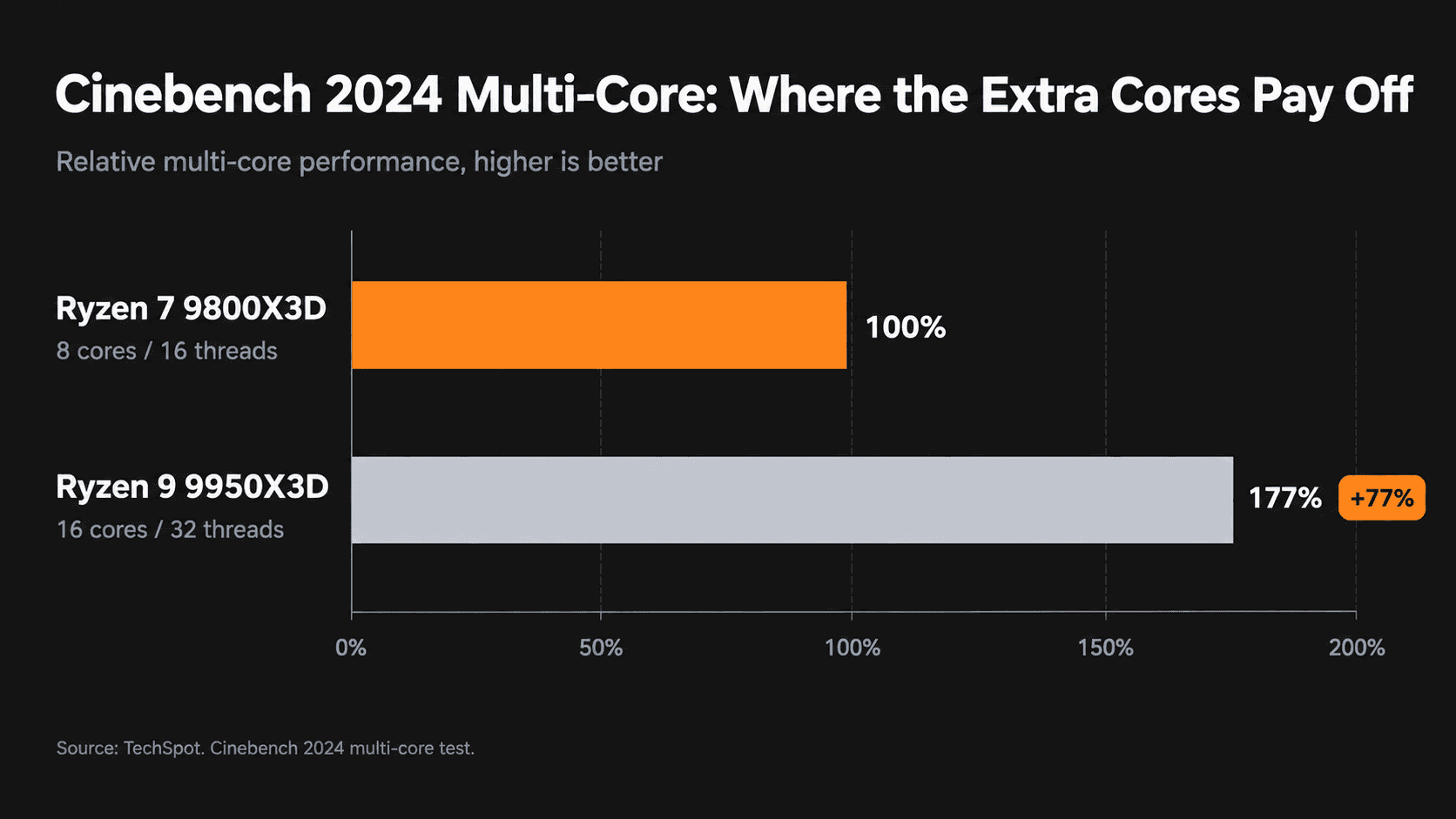
Outside of games, the two chips stop being twins. In Cinebench 2024's multi-core test, TechSpot measured the 9950X3D 77% faster than the 9800X3D. That's what doubling from 8 cores and 16 threads to 16 cores and 32 threads looks like when the software can use all of them, and it's the entire case for the more expensive chip.
| Workload (TechSpot) | Ryzen 7 9800X3D | Ryzen 9 9950X3D |
|---|---|---|
| Cores / threads | 8 / 16 | 16 / 32 |
| Cinebench 2024 multi-core | Baseline | 77% faster |
| Photoshop (out of the box) | Slightly faster | Slightly slower |
| Gaming (1080p averages) | Tie | Tie |
The applications that behave like Cinebench are the ones that split a job into many independent pieces: 3D rendering, compiling large codebases, exporting video, and compressing big archives. Those workloads hand each of the 9950X3D's 32 threads its own chunk of work, and they finish sooner because of it. If your day includes waiting on a progress bar in one of those apps, the second die is doing real work for you.
Not every creative app scales that way. Photoshop is the clearest counterexample in TechSpot's testing: it doesn't take full advantage of high-core-count CPUs, so the 9950X3D offered little improvement, and out of the box it was slightly slower than the 9800X3D. If your "productivity" is photo editing, the cheaper chip is the right one there too.
The honest way to decide is to count your hours. If heavy multi-core work is part of a normal week, for paid work or a serious hobby, the 77% uplift pays for itself in time saved. If it's something you do a few times a year, those eight extra cores sit parked or idle almost all of the time you own the chip, and you've paid $220 for hardware you rarely touch.
There's also a buyer for whom neither X3D chip is right. If you barely game and mostly render, GamersNexus points to the non-X3D Ryzen 9 9950X at its $500 to $520 price as the one to consider, because the 9950X3D gains little from its extra cache in GN's production benchmarks. You'd be paying for V-Cache that only helps in games you rarely play.
5. Power, Cooling, Platform, and the Other X3D Chips
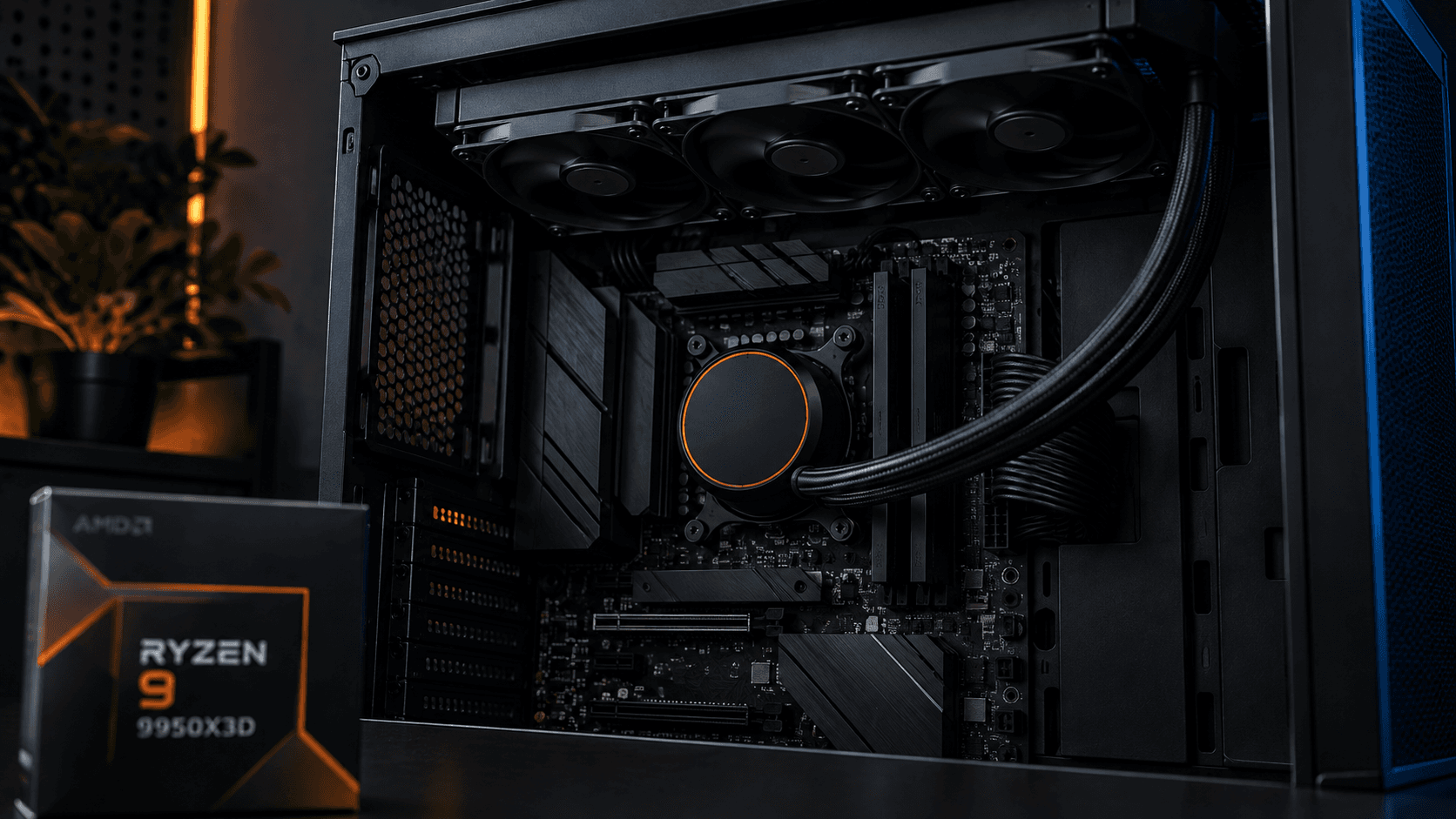
The price tag isn't the only cost of the bigger chip. Here's how the two compare on paper before we get to what they draw and how hot they run.
| Spec | Ryzen 7 9800X3D | Ryzen 9 9950X3D |
|---|---|---|
| Cores / threads | 8 / 16 | 16 / 32 |
| Base clock | 4.7 GHz | 4.3 GHz |
| Boost clock | Up to 5.2 GHz | Up to 5.7 GHz |
| L3 cache | 96MB | 128MB |
| CCDs (dies) | 1 | 2 |
| TDP | 120W | 170W |
| Released | November 2024 | March 12, 2025 ($699 MSRP) |
That 120W versus 170W TDP gap shows up in testing. In TechSpot's review, the 9950X3D consumed 44% more power than the 9800X3D in Cyberpunk 2077, even though both chips delivered the same frame rates. Under sustained all-core load, the numbers climb further: after half an hour of looping Cinebench's multi-core test in an ATX case with a 360mm AIO, TechSpot recorded an average core clock of 5,085 MHz, a peak temperature of 84°C, and 229W of draw across the EPS12V rails. That's on a large liquid cooler. Plan for a 360mm AIO or a high-end air cooler with the 9950X3D; a budget single-tower cooler is the wrong pairing for a chip pulling that much power during a long render.
On the platform side, both chips are simple upgrades. They drop into existing AM5 motherboards, though you may need to flash a BIOS update first, so check your board maker's support page for the minimum version before pulling your old CPU. Looking further out, AMD documentation suggests Zen 4 and Zen 5 owners will be able to move to Zen 6 without buying a new motherboard. That documentation gives no date, and VideoCardz reports the Olympic Ridge desktop chips aren't expected before 2027 at the earliest. Your board has at least one more generation of upgrades left in it, which is the strongest argument for not overspending on a CPU today.
Ryzen 7 9850X3D: A Faster Clock You Won't Notice
The 9850X3D launched on January 29, 2026, at $499, with a 5.6 GHz boost clock against the 9800X3D's 5.2 GHz. Tom's Hardware's head-to-head concluded that an extra $30 buys very little performance, and today's street gap is wider than that: $484 at Amazon and B&H, about $45 to $50 over the 9800X3D. Same core count, same cache, a clock bump that doesn't move frame rates in any way you'll feel. Put that money toward your graphics card instead.
Ryzen 9 9950X3D2: Do Not Buy
The 9950X3D2 costs $899, and neither major review found a reason to pay it. GamersNexus called it simply too expensive for a chip that rarely does much of anything, if anything at all, to improve performance. Tom's Hardware classed it as a workstation-class processor with little to no gaming advantage and even slight regressions in some titles. The 9950X3D does the same job for more than $200 less.
6. Who Should Buy the 9800X3D
This is the right chip for most people reading this. If your PC is primarily a gaming machine, at any resolution, the 9800X3D gives you the same frame rates as the 9950X3D for about $220 less at today's prices. At 1080p the two tie. At 1440p and 4K your graphics card carries more of the load, which makes the more expensive chip even harder to justify.
Streamers belong here too, as long as the stream is encoded on the graphics card. NVENC on NVIDIA cards and AMF on AMD cards handle the video work on the GPU, which leaves the 9800X3D's eight cores free to run the game. The extra cores on the 9950X3D would have nothing to do.
It's also the obvious upgrade for anyone running a Ryzen 7000 non-X3D chip on an AM5 board. You keep the motherboard and the DDR5, update the BIOS if needed, swap the processor, and pick up AMD's gaming cache without rebuilding anything. The 9800X3D doesn't ship with a cooler, but at 120W it doesn't demand the heavyweight cooling the 9950X3D does.
Finally, the 9800X3D is the smart pick for anyone planning a Zen 6 upgrade later. Zen 6 is confirmed for AM5, with no date yet and 2027 as the earliest expected window. The roughly $220 you don't spend on the 9950X3D today is a meaningful chunk of that future CPU, or of a graphics card upgrade right now, which will do far more for your frame rate than eight parked cores.
Who is it wrong for? Anyone who renders, compiles, or exports video every week, where the 9950X3D's 77% multi-core advantage turns into hours saved. And if you're still on AM4, this whole comparison assumes a platform you don't have yet: either chip means a new motherboard and DDR5 memory on top of the CPU price.
7. Who Should Buy the 9950X3D
Buy the 9950X3D if heavy multi-core work is part of your normal week: 3D rendering, video editing and export, or compiling code. That's where TechSpot's 77% Cinebench multi-core lead becomes real time back, every week, for as long as you own the chip.
It's also the right chip if you want one PC to do both jobs without compromise. The 9950X3D pairs the same top-tier X3D gaming performance as the 9800X3D with 16 cores for work, and that combination is the whole reason this chip exists. If you'd otherwise be choosing between a gaming chip and a workstation chip, the 9950X3D removes that choice.
Streamers who encode with x264 on the CPU are the third buyer. Software encoding is CPU work, and on an 8-core chip it competes with the game for the same cores. The 9950X3D's second set of eight cores gives the encoder room to work without fighting the game for resources. No major outlet has published gaming-while-streaming benchmarks for either chip, so treat this as the reasoning behind the recommendation, not a measured frame-rate gain. If you can switch to NVENC or AMF instead, the 9800X3D becomes the better buy again.
Budget for cooling before you order. At 170W TDP, 229W of measured full-load draw, and an 84°C peak on a 360mm AIO in TechSpot's testing, this chip needs a 360mm liquid cooler or a high-end air cooler. If your current cooler was chosen for a 120W chip, add a replacement to the cost.
Then watch the price. Today's $657.95 is above the buy zone. The 9950X3D has hit $569 twice this summer, so set a PCPartPicker price alert and buy when it drops back toward $569 to $600. The only reason to pay today's price is work that can't wait: if the chip saves you billable hours starting this month, the extra $60 to $90 over the deal price is cheaper than the time you'd lose waiting.
8. The Verdict
If you only game, or you stream using your graphics card's encoder, buy the Ryzen 7 9800X3D. Its gaming performance is identical to the 9950X3D, and the roughly $220 you save is better spent on your GPU or a future Zen 6 chip for the same AM5 board. Buy the Ryzen 9 9950X3D only if you render, compile code, or edit video every week. Even then, it's at $658 right now, well above the $569 it has sold for with coupons, so wait for a deal unless you need it today. Skip the 9850X3D and the 9950X3D2 entirely.
For a pure gamer, the smartest AM5 move is the cheaper chip now and a Zen 6 upgrade on the same board later. You get the same gaming performance as the $658 chip, and you keep $220 in your pocket for the upgrade that actually moves your frame rate next.
Frequently Asked Questions
Is the Ryzen 9 9950X3D faster than the 9800X3D for gaming?
No. They're effectively tied. Tom's Hardware measured the 9800X3D just 0.4% ahead across its 1080p suite, and TechSpot's 12-game average came out even. Individual games swing a few percent either way. During games, the 9950X3D parks its eight non-cache cores, so it behaves like an 8-core X3D chip. Paying more for it buys you no extra gaming performance.
Is the 9950X3D worth it for streaming?
Only if you encode your stream on the CPU with x264. If you use your graphics card's encoder (NVENC on NVIDIA, AMF on AMD), the video work happens on the GPU and the 9800X3D's eight cores handle the game fine. With x264, the 9950X3D's second set of eight cores gives the encoder room to work without fighting the game for resources. Even then, wait for a coupon price near $569 rather than paying today's $658.
Should I wait for Zen 6 instead of buying either chip?
AMD's documentation confirms Zen 6 desktop chips will work on AM5 boards, but it gives no launch date, and reports point to 2027 at the earliest. If your current AM5 CPU is holding back your games today, buy the 9800X3D now and treat Zen 6 as your next upgrade on the same board. If you're not hitting a CPU limit, waiting costs you nothing.
Is the Ryzen 7 9850X3D worth the extra money over the 9800X3D?
No. The 9850X3D launched at $499 with a higher 5.6 GHz boost clock, but Tom's Hardware found the extra money buys very little performance. It sells for $484 today, about $45-50 more than the 9800X3D, for a difference you won't notice in games. Buy the 9800X3D and put the savings toward your GPU.
Do I need a new motherboard or cooler for the 9950X3D?
Not a new motherboard. Both chips drop into existing AM5 boards, though you may need a BIOS update first. Cooling is a different story. The 9950X3D is rated at 170W versus the 9800X3D's 120W. In TechSpot's testing it drew 229W under full load and peaked at 84°C even on a 360mm liquid cooler, so a budget air cooler isn't enough.
What about the Ryzen 9 9950X3D2?
Skip it. At $899, GamersNexus found it rarely improves performance at all, and Tom's Hardware saw little to no gaming advantage, with slight regressions in some titles. It's a workstation chip at a workstation price. For gaming and mixed use, the 9950X3D does the same job for over $200 less.
What to Read Next
- CPU Upgrade Guide: Confirm the Bottleneck First → How to confirm your CPU is actually the bottleneck before spending $400+ on either chip.
- What to Upgrade First in Your PC → Where a CPU upgrade fits in the overall upgrade order.
- GPU Upgrade Guide → How to spend the ~$220 you save by choosing the 9800X3D on a GPU upgrade.